

When I first started working with SEO tools, one question kept appearing in forums, SEO groups, and marketing discussions: does Ahrefs get backlinks from Majestic?
At first glance, the question seems logical. When I analyze a website using different SEO tools, the backlink counts rarely match. One tool may show thousands of backlinks, while another shows fewer or sometimes even more. This naturally makes many people wonder whether tools like Ahrefs and Majestic share data or rely on each other’s backlink databases.
Understanding how backlink tools collect their data is extremely important for anyone doing SEO, link building, or competitor research. Backlinks remain one of the most important ranking signals in search engines, so accurate backlink analysis can directly influence SEO strategies and decisions.
In this guide, I will explain in detail:
- Whether Ahrefs gets backlinks from Majestic
- How backlink databases are actually built
- How Ahrefs and Majestic collect link data
- Why backlink numbers differ between SEO tools
- When to use Ahrefs or Majestic for backlink analysis
If you have ever been confused by inconsistent backlink reports, this guide will help you understand exactly what is happening behind the scenes.
Quick Fact:
No. Ahrefs and Majestic are entirely independent competitors. Ahrefs relies on AhrefsBot, which is currently the second most active web crawler globally (behind only Googlebot), while Majestic uses its own proprietary distributed crawler infrastructure (historically known as MJ12bot). Neither company shares, buys, or licenses backlink data from the other.
What Does It Mean When People Ask “Does Ahrefs Get Backlinks from Majestic?”
When someone asks does Ahrefs get backlinks from Majestic, they are usually trying to understand where SEO tools obtain their backlink data.
Backlink analysis tools rely on something called a link index.
A link index is essentially a massive database that stores information about web pages and the links connecting them. These indexes are built using automated web crawlers that continuously scan the internet.
These crawlers work similarly to search engine bots. They visit websites, read their content, identify links, and store this information in a database.
SEO professionals use these databases to:
- Discover backlinks pointing to a website
- Analyze competitor link profiles
- Identify link-building opportunities
- Monitor link growth or link loss
- Evaluate link quality and authority
Because backlink tools rely on different crawlers and databases, the results they produce are rarely identical.
This difference is exactly why many people assume tools might be sharing data.
While they don’t share data, both tools have expanded significantly: as of 2026, Ahrefs’ live index tracks over 35 trillion backlinks, whereas Majestic remains the leader for historical data with records dating back to 2004.”
Does Ahrefs Use Majestic’s Backlink Database?
The short and clear answer is no.
Ahrefs does not obtain backlinks from Majestic, and Majestic does not use Ahrefs data either.
Both platforms operate completely independent backlink indexes built using their own crawling technology.
Confirmed Facts
- Ahrefs runs its own web crawler called AhrefsBot.
- Majestic runs its own proprietary crawler infrastructure.
- Each company maintains a separate backlink database.
- Neither tool imports link data from the other.
Because of this independence, it is completely normal for backlink numbers to differ between the two platforms.
This difference is not a mistake or an error. Instead, it reflects how each platform crawls and processes the web.
The “API Factor”: Why Some Tools Look Identical?
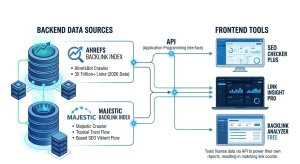
While Ahrefs and Majestic are independent, you may notice that some smaller, “all-in-one” SEO dashboards or cheap “Free Backlink Checkers” show data that matches one of these giants perfectly.
This isn’t because the industry is sharing data; it’s because those smaller tools are likely licensing data via API. Both Ahrefs and Majestic offer API access that allows third-party developers to pull their link indexes into separate interfaces. If a tool’s numbers look familiar, they are likely just a different “skin” for the same underlying database.
How Does Ahrefs Actually Find Backlinks?
Instead of relying on external sources, Ahrefs collects backlink data through its own large-scale crawling system.
The main component behind this system is AhrefsBot, a web crawler designed specifically for SEO link discovery.
How AhrefsBot Works?
The process generally follows several steps.
First, the crawler discovers web pages by following links across the internet. It starts with known pages and continues expanding its crawl network.
Second, when AhrefsBot visits a page, it scans the HTML and identifies all outgoing links.
Third, these links are stored and processed inside the Ahrefs backlink index.
Fourth, the system analyzes the links and assigns various metrics that help users evaluate link strength and authority.
What are the Key Features of the Ahrefs Backlink Index?
Ahrefs is known for maintaining one of the largest commercial backlink databases in the SEO industry.
Some important characteristics include:
- Continuous web crawling
- Frequent database updates
- Large-scale link discovery
- Advanced filtering of low-quality links
Ahrefs also calculates proprietary SEO metrics such as:
- Domain Rating (DR)
- URL Rating (UR)
These metrics help estimate the strength of a website’s backlink profile.
Because Ahrefs already maintains its own massive crawling infrastructure, it has no need to import backlink data from other SEO platforms.
How Does Majestic Collect Backlink Data?
Majestic operates in a similar way but with a slightly different structure for organizing link data.
Majestic also runs its own web crawler that scans the internet to discover links.
Instead of maintaining just one link index, Majestic separates its backlink database into two major components.
| Index Type | Purpose |
| Fresh Index | Contains recently discovered backlinks from recent crawls |
| Historic Index | Contains a much larger archive of links discovered over many years |
This dual-index approach allows Majestic to provide both recent link data and long-term historical backlink information.
Majestic also focuses heavily on evaluating link quality.
Two of its most well-known metrics include:
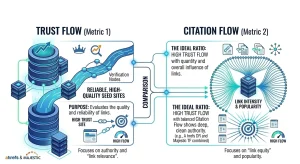
- Trust Flow – Measures the trustworthiness of a website based on its backlink sources
- Citation Flow – Measures the quantity and influence of links pointing to a site
These metrics are widely used by SEO professionals to assess link quality.
Ahrefs vs Majestic: Key Differences in Backlink Databases
Although both tools focus on backlink analysis, their systems and priorities differ.
To understand the scale of these operations, look at the sheer volume of data each crawler manages. As of early 2026, the gap between their “Live” and “Historic” philosophies is clear:
| Metric | Ahrefs (Live Index) | Majestic (Historic Index) |
| Total Backlinks | ~35 Trillion | ~21.7 Trillion (URLs found) |
| Indexed Pages | 456 Billion+ | 4.5 Trillion (Crawled) |
| Update Frequency | Every 15–30 Minutes | Daily (Fresh) / Monthly (Historic) |
| Best For | Real-time campaign tracking | Deep forensic link history |
Because of these differences, the two tools may highlight different parts of a website’s link profile.
Some backlinks might appear in Ahrefs but not Majestic, while others may appear in Majestic but not Ahrefs.
Advanced Nuance: Why SEO Pros Use Both (DR vs. TTF)
If you are a professional link builder in 2026, you likely use both tools because they measure “authority” using two completely different philosophies.
Ahrefs: Domain Rating (The Traffic & Equity Model)
Ahrefs’ Domain Rating (DR) is a measure of “link popularity.” It calculates the strength of a website based on the quantity and quality of unique domains linking to it.
- The Core Logic: If a site with a high DR links to you, your DR goes up.
- Pro Tip: Ahrefs is excellent for estimating how much “ranking power” a site can pass, but it doesn’t always tell you if that site is relevant to your specific niche.
Majestic: Topical Trust Flow (The Relevance & Niche Model)
Majestic’s Topical Trust Flow (TTF) is arguably the more “surgical” metric. It doesn’t just look at link power; it categorizes the nature of the link.
- The Core Logic: Majestic classifies the web into over 800 categories (e.g., Health / Pharmacy or Computers / Software).
- Pro Tip: If you are a tech blog, a link from a DR 80 “Cooking Site” might look good in Ahrefs, but Majestic will show you that the link has zero “Technology” trust. In 2026, Google values relevance over raw power, making TTF a vital metric for avoiding “link spam.”
| Feature | Ahrefs (DR) | Majestic (TTF) |
| Primary Focus | Link Equity & Popularity | Niche Relevance & Trust |
| Calculation Basis | Logarithmic scale of all links | Proximity to “Seed” trusted sites |
| Key Use Case | Competitive ranking analysis | Identifying niche-specific authority |
Why Do Different SEO Tools Show Different Backlink Counts?
This is one of the most common questions among SEO professionals.
When someone sees different backlink counts across tools, they often assume something is wrong.
In reality, several factors contribute to these differences.
Different Crawlers
Each SEO platform uses its own crawler with its own crawl priorities.
Some crawlers may discover certain websites earlier than others.
Crawl Frequency
The internet changes constantly. New pages appear, links are added, and some pages disappear.
SEO tools update their indexes at different speeds.
Link Filtering
Backlink tools apply filters to remove low-quality or spam links.
Because each tool uses different filtering algorithms, the final backlink count may vary.
Crawl Coverage
Even the largest crawler cannot scan the entire internet at once.
Each tool captures only a portion of the web at any given time.
For these reasons, backlink tools should be seen as data estimators rather than exact mirrors of the internet.
Do Any SEO Tools Share Backlink Databases?
In most cases, major SEO tools do not share backlink databases.
Companies like Ahrefs and Majestic invest heavily in building their own crawling infrastructure.
Running a web crawler at global scale requires:
- Massive server networks
- Large storage systems
- Advanced crawling algorithms
- Continuous maintenance and development
Because of this investment, these companies maintain their own proprietary datasets.
Confirmed Facts
- Ahrefs operates an independent crawler.
- Majestic operates an independent crawler.
- Most large SEO platforms collect their own link data.
Proposed or Discussed Ideas
Some smaller SEO tools may license data from larger providers.
Common Misinformation
A widespread myth suggests that Ahrefs imports backlink data from Majestic, but this claim has never been supported by evidence.
When Should You Use Ahrefs vs Majestic for Backlink Analysis?
Both tools are powerful, but they are often used for slightly different purposes.
When I Use Ahrefs?
I prefer using Ahrefs for broader SEO analysis because it provides many additional tools beyond backlinks.
These include:
- Keyword research
- Competitor analysis
- Content gap analysis
- Rank tracking
- Site auditing
Ahrefs is especially useful when building a full SEO strategy.
When I Use Majestic?
Majestic is particularly valuable when focusing specifically on link analysis.
It provides deeper insights into link trust and network relationships.
Some SEO professionals use Majestic for:
- Advanced link profile investigations
- Evaluating backlink trust signals
- Identifying suspicious link networks
Because the two tools emphasize different aspects of SEO, many professionals choose to use both tools together.
Link Graph vs. Visual Assets In 2026, SEO isn’t just about lists; it’s about patterns. A major point of differentiation is how these tools visualize data:
- Majestic Link Graph: This tool is a game-changer for spotting Private Blog Networks (PBNs). It maps out the “clusters” of websites linking to each other, allowing you to see if a site is part of a “neighborhood” of spam or high-authority sites.
- Ahrefs Visual Assets: Ahrefs focuses more on growth trends. Their charts make it incredibly easy to see Link Velocity, the rate at which you are gaining or losing links—which is a primary signal for Google’s ranking algorithms.
Real-Life Example: Why Two Tools Show Different Backlinks?
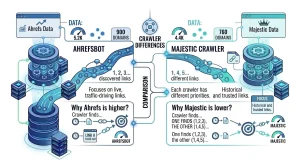
Let’s imagine I analyze a website using both tools.
When I check the domain in Ahrefs, the report might show:
- 5,200 backlinks
- 900 referring domains
When I check the same domain in Majestic, the results might show:
- 4,400 backlinks
- 760 referring domains
At first glance, this difference may look confusing.
However, the explanation is simple.
Each crawler discovered different links across the web.
Some backlinks were found by Ahrefs first, while others were discovered by Majestic.
This variation is completely normal and happens frequently when comparing SEO tools.
Common Misinformation About Ahrefs and Majestic
Confirmed Facts
- Both tools operate independent crawling infrastructures.
- Both tools maintain proprietary backlink databases.
- Backlink data is collected directly through web crawling.
Proposed or Discussed Ideas
Some SEO professionals speculate that certain smaller tools may rely on third-party link data providers.
False Claims
One of the most common misconceptions is that Ahrefs uses Majestic’s backlink database.
This is incorrect. Both companies have built their own link indexes over many years.
Final Thoughts: Does Ahrefs Get Backlinks from Majestic?
To summarize clearly, Ahrefs does not get backlinks from Majestic.
Both platforms independently crawl the internet and maintain their own backlink databases.
Differences in backlink numbers are completely normal because:
- Each crawler scans the web differently
- Each database updates at different speeds
- Each platform filters and processes links differently
For SEO professionals, the most important takeaway is this:
No single tool provides a complete picture of the internet’s link structure.
Using multiple backlink tools can often provide deeper insights and help identify links that one database may have missed.
Understanding how backlink databases work will allow you to interpret SEO data more accurately and make better strategic decisions.
Frequently Asked Questions
Does Ahrefs purchase backlink data from other SEO tools?
No. Ahrefs collects backlink data using its own crawler infrastructure and does not rely on other SEO tools for link data.
Why are backlink numbers different across SEO tools?
Backlink counts differ because each platform crawls the internet independently and processes link data using different algorithms.
Which tool has the most accurate backlink data?
No tool has perfect accuracy because the internet is constantly changing. Each platform provides a different snapshot of link data.
Is Majestic only used for backlink analysis?
Majestic mainly focuses on backlink intelligence and link quality evaluation rather than providing a full SEO toolkit.
Can a website have backlinks that no SEO tool discovers?
Yes. Some pages may not be crawled yet, meaning certain backlinks may temporarily remain undiscovered.
Why do SEO professionals compare multiple backlink tools?
Using multiple tools helps identify additional links and provides a broader understanding of a website’s link profile.
Do search engines use the same backlink data as SEO tools?
Search engines maintain their own internal link databases that are far larger than those available to public SEO tools.