

In the evolving world of search engine optimization, backlinks remain one of the most influential ranking factors. However, not all backlinks contribute positively to your website’s growth.
When I analyze SEO performance, one of the most overlooked yet critical elements is identifying harmful links. Understanding how to find toxic backlinks is not just a technical skill, it is a necessary practice for maintaining long-term visibility and trust in search engines.
A backlink should ideally act as a signal of credibility. When authoritative and relevant websites link to your content, it strengthens your position in search results.
But when links originate from suspicious, irrelevant, or manipulative sources, they can send negative signals instead. Over time, these signals can dilute your website’s authority and even result in ranking declines.
The challenge is that toxic backlinks are not always obvious. They can accumulate gradually, often without your direct involvement. This is why a structured and informed approach to backlink analysis is essential.
As many SEO professionals emphasize:
“Backlinks are powerful, but only when they come from the right places.”
This guide provides a detailed, practical, and carefully balanced explanation of how to identify toxic backlinks, understand their impact, and take appropriate action without risking your website’s performance.
What Are Toxic Backlinks and Why Do They Matter for SEO?
Toxic backlinks are links that originate from websites or pages that search engines consider untrustworthy, manipulative, or irrelevant. These links often violate search engine guidelines because they are created to artificially influence rankings rather than provide genuine value.
Search engines evaluate backlinks based on multiple layers of trust. These include the authority of the linking domain, the relevance of the content, and the overall linking behavior of the site. When a backlink fails to meet these criteria, it may be interpreted as a negative signal.
Toxic backlinks commonly come from:
- Websites built purely for link manipulation
- Domains filled with duplicate, spun, or low-quality content
- Pages overloaded with unrelated outbound links
- Networks designed to artificially inflate rankings
The reason these links matter is rooted in how search engines interpret intent. A natural backlink profile typically grows gradually and includes links from a variety of relevant sources. In contrast, a profile filled with spammy or irrelevant links can appear artificial.
“Search engines don’t just evaluate links, they evaluate trust.”
Even though modern algorithms are better at ignoring certain spam signals, they are not perfect. A high concentration of toxic backlinks can still weaken your website’s perceived credibility.
How Do Toxic Backlinks Affect Your Website Rankings?
The effect of toxic backlinks is often subtle at first, which makes them particularly difficult to detect. Instead of causing immediate penalties, they may gradually erode your site’s authority over time.
One of the primary ways toxic backlinks affect rankings is by weakening trust signals. Search engines rely heavily on trust when determining which pages deserve top positions. If your backlink profile appears unreliable, your rankings may decline, even if your content is strong.
Another impact is the dilution of positive signals. High-quality backlinks can lose effectiveness when surrounded by a large number of low-quality or manipulative links. This creates a situation where your strongest SEO assets are undermined.
There are also two distinct types of negative outcomes:
Algorithmic Adjustments
Search engine algorithms continuously scan backlink profiles for unnatural patterns. If suspicious activity is detected, rankings may be adjusted downward without any direct notification.
Manual Actions
In more severe cases, a human reviewer may apply a manual penalty. This typically happens when there is clear evidence of intentional manipulation, such as participation in link schemes.
It is important to recognize that not every weak backlink leads to a penalty. Search engines are designed to ignore many low-quality links. However, when patterns of manipulation emerge, the risk increases significantly.
How I Check Toxic Backlinks Using the Semrush Tool?
When I audit a website’s backlink profile, I prefer using the Semrush Backlink Audit tool because it provides a structured and reliable way to identify potential risks. Instead of relying on assumptions, this process allows me to evaluate backlinks based on real data, patterns, and domain-level signals.
Below is the exact step-by-step approach I follow when checking for toxic backlinks.
Step 1: Search for My Domain in Semrush
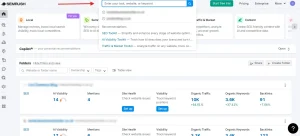
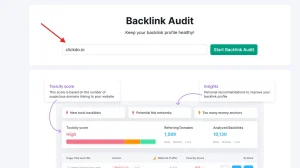
I begin by entering my domain into the Semrush search bar. In this example, I use clickdo.io as the domain I want to analyse.
This step acts as the starting point, allowing Semrush to pull together all available SEO data related to the domain. It ensures that I am working with a centralized dataset rather than fragmented information from multiple sources.
Step 2: Access the Website Dashboard
Once the domain is entered, Semrush takes me to the main dashboard of the website. This dashboard provides a high-level overview of the domain’s SEO performance, including traffic insights, keyword data, and backlink summaries.
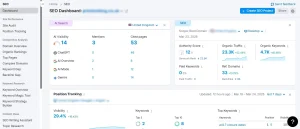
At this stage, I don’t dive too deep into the data. Instead, I use the dashboard as a navigation hub to access more specific tools related to backlink analysis.
Step 3: Navigate to Backlink Audit
From the dashboard, I move to the left-hand menu and locate the Link Building section. Under this category, I click on Backlink Audit.
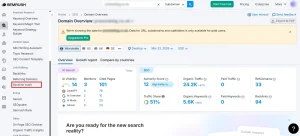
This is where Semrush shifts from general SEO insights to a focused backlink evaluation. The Backlink Audit tool is specifically designed to identify potentially harmful links and assess the overall health of a backlink profile.
Step 4: Enter the Domain for Audit Setup
After selecting the Backlink Audit tool, Semrush prompts me to enter the domain again. This step is part of setting up the audit project.
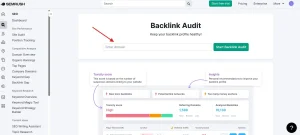
I enter clickdo.io once more to ensure the analysis is correctly configured for the domain I want to evaluate. This setup phase allows Semrush to prepare its scanning process and apply its toxicity detection algorithms.
Step 5: Analyse Results and Review Backlink Insights
Once the audit is initiated, Semrush begins analysing the entire backlink profile. This process goes beyond simply listing links, it evaluates them using a combination of signals, including domain authority indicators, backlink patterns, and WHOIS-based categorisation to better understand the origin and credibility of linking domains.
After the analysis is complete, I review the results in detail.
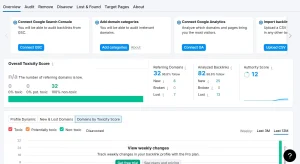
The first thing I check is the toxicity score and flagged domains. In this case, the report showed 0 toxic links, which indicates that the backlink profile is currently clean and does not raise immediate concerns. While this is a positive outcome, I do not stop my analysis there.
I then move on to the referring domains section, which gives a broader view of the websites linking to the domain. This section allows me to understand how the backlink profile is evolving by showing whether referring domains are newly acquired, lost over time, or broken. These changes can reveal patterns such as sudden link drops or unusual spikes that may require further investigation.
Next, I review the analysed backlinks data, where Semrush categorises backlinks into groups such as new, broken, and lost. This breakdown is particularly useful for identifying trends. For example, a sudden increase in broken backlinks may indicate removed pages or site restructuring, while a surge in new backlinks may require closer inspection to ensure they are legitimate.
Finally, I examine the Authority Score, which provides an overall indication of the domain’s strength and trustworthiness. Although this score should not be used in isolation, it helps me quickly assess whether the backlink profile aligns with a healthy and credible website.
What makes this step especially valuable is that it brings multiple insights together in one place. Instead of analysing backlinks individually, I can view the entire profile from a strategic perspective, understanding not just which links exist, but how they behave over time.
Pro-Tip: Interpreting the Toxicity Score
Semrush doesn’t just guess if a link is bad; it uses over 45 “Toxic Markers” to give every link a score from 0 to 100. To audit like a pro, you need to know these thresholds:
- Score 60–100 (High Risk): These are “Toxic.” They often come from known link networks, spammy directories, or sites with zero organic traffic. These require immediate investigation.
- Score 45–59 (Medium Risk): These are “Potentially Toxic.” They might be from irrelevant niches or sites with poor layouts. Review these manually before taking action.
- Score 0–44 (Low Risk): Generally safe. These are “Non-Toxic” links that usually come from reputable or neutral sources.
Why This Process Is Important?
This structured approach allows me to go beyond simply identifying toxic backlinks. It helps me understand the full context of a website’s backlink profile, including stability, growth patterns, and overall quality.
Even when the results show no toxic links, as in this case, the process is still essential. Backlink profiles are constantly changing, and new links can appear at any time. Regular monitoring ensures that any potential issues are identified early, before they have a chance to impact rankings.
More importantly, this method reinforces a key principle in SEO:
“A healthy backlink profile is not just about avoiding bad links, it’s about maintaining consistency, relevance, and trust over time.”
By following this process, I can confidently assess backlink health and make informed decisions that support long-term SEO performance.
What Makes a Backlink Toxic?
A backlink becomes toxic when it signals manipulation rather than genuine endorsement. The context in which the link appears is often more important than the link itself.
Key characteristics of toxic backlinks include:
- Lack of topical relevance
- Placement on low-quality or spam-heavy pages
- Association with known link networks
- Use of deceptive or keyword-stuffed anchor text
Another critical factor is the linking behavior of the site. If a website links out to hundreds of unrelated domains, it is unlikely to be considered trustworthy.
Intent plays a central role here. If a link exists primarily to influence rankings rather than provide value to users, it is more likely to be flagged as toxic.
Toxic vs Low-Quality Backlinks: Understanding the Difference
One of the most important distinctions in backlink analysis is the difference between toxic and low-quality links. Misunderstanding this can lead to unnecessary or even harmful actions.
| Aspect | Toxic Backlinks | Low-Quality Backlinks |
| Nature | Manipulative | Neutral |
| Risk Level | High | Low |
| SEO Impact | Potentially harmful | Often ignored |
| Recommended Action | Remove or disavow | Monitor |
Low-quality backlinks often come from small or newly created websites. While they may not contribute significantly to your SEO, they are not inherently dangerous.
Toxic backlinks, on the other hand, are typically part of manipulative practices and require closer attention.
The 2026 Reality: How Google’s SpamBrain AI Handles Toxic Links
In the past, SEOs lived in fear of “Negative SEO” attacks. Today, the landscape has shifted. Google now uses SpamBrain, an AI-based spam-prevention system that operates in real-time.
Instead of just looking for “bad sites,” SpamBrain identifies patterns of manipulation. If a site suddenly gains 5,000 links from a known PBN (Private Blog Network), the AI doesn’t just penalize the site, it often simply neutralizes the links, making them pass zero value.
Key Update for 2026: Google’s August 2025 Spam Update made SpamBrain even more “surgical.” It can now ignore the toxic portion of your backlink profile while still giving you credit for your high-quality, editorial links.
The Case Against Disavowing: When to Leave Links Alone
One of the most common mistakes I see is “Panic Disavowing.” Before you upload a disavow file, you must understand that the Disavow Tool is a double-edged sword.
Google’s John Mueller has famously stated that for most websites, managing a disavow file is a “billable waste of time.” In a 2026 update, he reminded SEOs that the tool is “not a religion” and should be used with extreme discipline.
Do NOT disavow if:
- The links are just “random”: A few stray links from a foreign-language scraper site are normal. Google expects this and ignores them automatically.
- The links are “NoFollow”: These links already tell Google not to pass authority; disavowing them is redundant.
- You don’t have a Manual Action: If your Search Console doesn’t show a “Manual Penalty” notification, the risk of accidentally disavowing a “neutral” link that was actually helping you is high.
ONLY disavow if:
- You have a confirmed Manual Action for “Unnatural Inbound Links.”
- You (or a previous agency) intentionally bought low-quality link packages or used “Black Hat” tactics in the past.
- You are being targeted by a massive, sustained Negative SEO attack (thousands of links daily) that is clearly tanking your rankings.
How to Remove Toxic Backlinks Safely?
Removing toxic backlinks is often the safest and most effective solution when possible. This process involves contacting the website owner and requesting that the link be removed.
The outreach process requires patience and professionalism. Clear communication increases the likelihood of a positive response.
In situations where removal is not feasible, documenting your efforts can still be valuable, especially if further action is needed.
How to Disavow Toxic Backlinks Using Google Tools?
Disavowing backlinks is a more advanced step that should be approached with caution. It involves telling Google to ignore specific links when evaluating your website.
This process is particularly useful when:
- The linking website does not respond to removal requests
- The backlink profile shows clear signs of manipulation
- There is a risk of penalty
Creating an accurate disavow file requires careful review. Including the wrong links can negatively impact your SEO.
Can You Ignore Toxic Backlinks?
There is no one-size-fits-all answer to this question. In some cases, search engines may automatically ignore spammy links, reducing the need for intervention.
However, this does not eliminate the need for monitoring. If toxic backlinks begin to form patterns or increase rapidly, taking action becomes more important.
The decision to act should always be based on:
- The volume of suspicious links
- The consistency of patterns
- The overall health of your backlink profile
How to Prevent Toxic Backlinks in the Future
Prevention is a long-term strategy that focuses on building a strong and natural backlink profile. This involves prioritizing quality over quantity and avoiding risky practices.
Consistent monitoring is also essential. Regular audits help identify issues early, making them easier to manage.
Ethical link-building practices, such as creating valuable content and building genuine relationships, provide a more sustainable path to growth.
Real-Life Example: Fixing a Toxic Backlink Profile
To illustrate the practical impact, consider a scenario where an eCommerce website experiences a sudden decline in traffic.
Upon analysis, a large number of backlinks were found to originate from irrelevant and low-quality domains. These links had been acquired through outdated link-building practices.
The recovery process involved:
- Conducting a detailed backlink audit
- Removing a portion of harmful links through outreach
- Disavowing the remaining toxic domains
Over time, the website’s rankings stabilized, and traffic began to recover. This example highlights the importance of proactive backlink management.
Key Takeaways on How to Find Toxic Backlinks
Understanding how to find toxic backlinks is an essential component of modern SEO. It requires a thoughtful and balanced approach that combines technical analysis with practical judgment.
The most effective strategy involves:
- Regularly reviewing your backlink profile
- Focusing on relevance and intent
- Taking action only when necessary
By maintaining a clean and trustworthy backlink profile, you create a stronger foundation for sustainable growth and improved search visibility.
FAQs
How can I identify patterns in toxic backlinks?
Patterns often appear as repeated anchor text, clusters of links from similar domains, or sudden spikes in backlinks from unrelated niches.
Is it possible for competitors to create toxic backlinks to my site?
Yes, this is sometimes referred to as negative SEO. While search engines try to mitigate its impact, monitoring your backlinks is still important.
Do nofollow links pose any risk?
In most cases, nofollow links do not pass authority and are unlikely to cause harm, but they should still be reviewed for overall profile health.
Should I rely only on one SEO tool for backlink analysis?
Using multiple tools provides a more complete view, as each platform may detect different backlinks and risk signals.
Can removing backlinks improve rankings immediately?
Improvements usually take time, as search engines need to reprocess your backlink profile.
Are directory links considered toxic?
Not always. Some directories are legitimate, while others are spammy. The quality and relevance of the directory matter.
What is the safest way to maintain a healthy backlink profile?
Regular audits, ethical link-building practices, and focusing on high-quality content are the most reliable methods.