

In search engine optimisation (SEO), understanding the strength and credibility of a website is an essential step before building backlinks, analysing competitors, or planning content strategies. One metric that SEO professionals frequently use for this purpose is Domain Authority (DA).
When managing or analysing websites, I often need a quick way to estimate whether a website is strong enough to compete in search results. Instead of relying only on guesswork, I check its Domain Authority score, which gives a reliable comparative measure of a website’s authority within its niche.
Learning how to check DA of a website can help you:
- Evaluate the SEO strength of a website
- Analyse competitors in your industry
- Identify high-quality backlink opportunities
- Track the growth of your website over time
In this detailed guide, I will explain what Domain Authority means, how it works, how to check it using different tools, and how it can influence your SEO strategy.
What Is Domain Authority in SEO?
Domain Authority (DA) is a search engine optimisation metric developed by Moz that predicts how likely a website is to rank in search engine results pages (SERPs).
The score ranges from 1 to 100, where:
- Lower numbers indicate weaker ranking potential
- Higher numbers indicate stronger authority and ranking potential
Domain Authority is calculated using a combination of factors, primarily focused on backlink quality and quantity.
However, it is important to understand that Domain Authority is not a Google ranking factor. Instead, it is a third-party metric used to estimate how strong a website might be compared to others.
Understanding the Meaning of Domain Authority
Domain Authority measures the overall strength of a website’s domain rather than a single webpage.
The calculation includes multiple signals, such as:
- Number of backlinks pointing to the site
- Quality of those backlinks
- Number of unique referring domains
- Link trust and spam signals
- Overall link profile of the domain
For example:
If two websites publish similar content but one has significantly stronger backlinks, the site with better backlinks will typically have a higher Domain Authority score.
Because of this, DA is often used as a competitive comparison tool rather than an absolute measurement.
Who Created the Domain Authority Metric?
Domain Authority was created by Moz, one of the most recognised companies in the SEO industry.
Moz designed this metric to help marketers estimate a website’s ranking potential without needing access to Google’s internal algorithms.
Over time, Domain Authority became widely used by:
- SEO professionals
- content marketers
- digital agencies
- website owners
Today, many SEO tools provide similar metrics, such as:
| Tool | Authority Metric |
| Moz | Domain Authority |
| Ahrefs | Domain Rating |
| SEMrush | Authority Score |
| Majestic | Trust Flow |
Each metric uses its own algorithm but generally evaluates the strength of a website’s backlink profile.
Why Domain Authority Matters for Website SEO?
Domain Authority helps website owners and marketers understand how competitive their website is compared to others in the same industry.
Here are some practical uses of DA:
1. Competitor Analysis
Checking the DA of competitor websites helps determine how strong their SEO presence is.
If most competitors have DA scores between 40 and 60, a new website with DA 10 may need significant link building and content development to compete.
2. Backlink Opportunity Evaluation
Before building backlinks, many SEO professionals evaluate the authority of potential websites.
A backlink from a DA 60 website usually provides more value than one from a DA 10 website.
3. Tracking SEO Progress
As a website gains backlinks and improves its SEO structure, the Domain Authority score typically increases over time.
Monitoring this growth helps measure the success of long-term SEO efforts.
How Do I Check the DA of a Website?
When I want to quickly check the authority of a website, I often use the free Ahrefs website authority checker. It provides useful insights about a domain’s backlink strength and overall SEO authority. Below is the simple process I follow when checking the authority of www.clickdo.io.
Step 1: Open the Free Ahrefs Domain Authority Checker
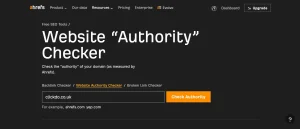
First, I visit the Ahrefs Website Authority Checker page. This tool allows me to analyse a domain’s backlink strength without needing a paid subscription.
The Ahrefs checker is helpful because it provides metrics such as Domain Rating (DR), backlink counts, and referring domains. Although Ahrefs uses Domain Rating instead of Moz’s Domain Authority, both metrics serve a similar purpose: estimating how strong a website’s backlink profile is.
Step 2: Enter the Website URL
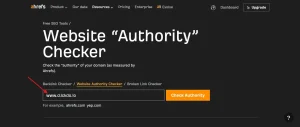
Once the tool loads, I enter the full domain name of the website I want to analyse.
For this example, I type:
www.clickdo.io
Entering the correct domain ensures the tool analyses the entire website rather than just a specific page.
Step 3: Run the Authority Check
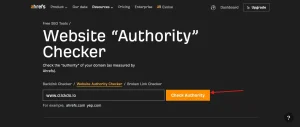
After entering the domain, I click the Check Authority or Analyse button.
At this stage, the Ahrefs system scans its backlink database and gathers information related to the website’s link profile. The tool evaluates factors such as the number of backlinks pointing to the domain and how many unique websites are linking to it.
This process only takes a few seconds.
Step 4: Review the Metrics Provided by the Free Ahrefs Tool
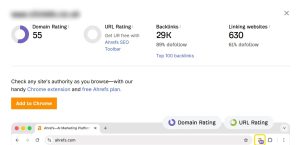
The free Ahrefs authority checker displays a few important metrics that help evaluate the strength of the website.
These include:
Domain Rating (DR)
This is Ahrefs’ authority score that estimates the strength of the website’s backlink profile on a scale from 0 to 100. A higher DR generally indicates a stronger backlink profile.
Backlink Count
This shows the total number of backlinks pointing to the website from across the internet.
Linking Websites (Referring Domains)
This metric shows how many unique websites link to the domain. In SEO, having backlinks from multiple different websites is usually more valuable than many links from a single site.
DoFollow Backlinks
The tool also shows how many of the backlinks are DoFollow links. These links pass SEO authority and are important for improving a website’s ranking potential.
Why These Metrics Are Useful?
Even though the free Ahrefs tool shows only a few metrics, they provide a quick overview of a website’s backlink strength.
When I check www.clickdo.io, these metrics help me understand:
- how strong the website’s backlink profile is
- how many websites are linking to it
- how many links are passing SEO value through DoFollow attributes
This quick analysis helps determine the overall authority and credibility of the website from an SEO perspective.
How to Check the “Official” Moz Domain Authority?
While Ahrefs is excellent for checking Domain Rating (DR), Moz is the only tool that provides the official Domain Authority (DA) score. If you need the exact metric used by most SEO agencies, follow these steps:
Step 1: Visit the Moz Domain Analysis Tool
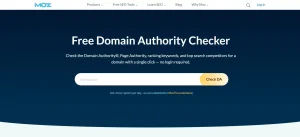
Head over to the Moz Domain Analysis page. This is the fastest way to get a high-level snapshot of any URL’s performance.
Step 2: Enter the Domain Details
Type the website URL into the search bar and hit “Analyze Domain.” > Note: You’ll get a few free searches per day, but you may need to log into a free Moz community account to see the full data
Step 3: Get Your Authority Metrics
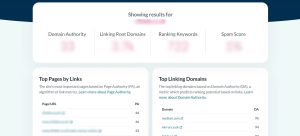
Moz will immediately generate a dashboard featuring these four critical data points:
- Domain Authority (DA): A score from 1 to 100 that predicts how likely a website is to rank on search engine result pages (SERPs).
- Linking Root Domains: The total number of unique websites linking to the domain. Quality matters more than quantity here!
- Ranking Keywords: The number of search terms for which this site ranks in the top 100 positions.
Which Tools Can Check the Domain Authority of a Website?
Several SEO tools provide authority metrics that help evaluate website strength.
Below are some commonly used tools.
Moz Domain Authority Checker
Moz provides the original Domain Authority metric.
Its Link Explorer tool allows users to check:
- Domain Authority
- Page Authority
- backlink profile
- spam score
Moz is widely trusted because it created the DA metric itself.
Ahrefs Website Authority Checker
Ahrefs uses a similar metric called Domain Rating (DR).
Domain Rating measures the strength of a website’s backlink profile based on referring domains.
Ahrefs is particularly useful for:
- backlink analysis
- competitor research
- keyword tracking
SEMrush Authority Score Tool
SEMrush calculates an Authority Score, which combines multiple factors including:
- backlinks
- organic traffic
- trust signals
This metric gives a broader overview of a website’s SEO strength.
Free Domain Authority Checker Tools
Many free tools allow quick DA checks.
These tools are useful for beginners who want a basic understanding of domain authority.
Examples include:
- Small SEO Tools
- PrePostSEO
- Website SEO Checker
Although free tools may provide limited data, they are often sufficient for simple DA checks.
What Is a Good Domain Authority Score?
A common question beginners ask is:
What is considered a good Domain Authority score?
The answer depends largely on the competition within your niche.
Domain Authority Score Range Explained
| DA Score | Website Strength |
| 1 – 20 | New or very small websites |
| 21 – 40 | Growing websites |
| 41 – 60 | Established websites |
| 61 – 80 | Highly authoritative websites |
| 81 – 100 | Major global websites |
Examples of websites with very high DA scores include large platforms like Wikipedia, Google, and YouTube.
What DA Score Is Considered Strong for SEO?
For most websites:
- DA 30+ indicates solid progress
- DA 50+ indicates strong authority
- DA 70+ indicates a highly trusted domain
However, the most meaningful comparison is within your own industry.
A local business website with DA of 25 may still perform very well if competitors have similar scores.
Why Small Websites Usually Have Lower DA?
New websites often start with very low Domain Authority because they lack:
- strong backlink profiles
- domain age
- brand mentions
- established content libraries
Over time, as the website earns backlinks and publishes valuable content, its DA score gradually increases.
The “AI Threshold”: DA Scores in the Age of AI Overviews
In 2026, a “good” DA score is no longer just about ranking #1—it’s about being the primary source for AI-generated search summaries.
Our research into AI Overviews shows a clear trend:
- The DA 40+ Baseline: For broad, competitive topics, AI engines typically pull citations from websites with a DA of 40 or higher. These sites have enough established “Trust” for the AI to confidently repeat their information.
- The Niche Exception: If your DA is low (under 30), you can still appear in AI Overviews by having ultra-high topical relevance. If you are the only site providing a specific, deep answer to a complex question, the AI will prioritize your expertise over a high-DA generalist site.
The takeaway: If your goal is to be the “Suggested Source” in an AI search result, aim for a DA of 45+ while maintaining a 100% focus on your core topic.
The “DA Trap”: Why a High Score Can Sometimes Be Misleading?
While a high Domain Authority (DA) score looks impressive, it doesn’t always tell the whole story. In my experience analyzing thousands of domains, I’ve found that a high DA can be “faked” by link farms or expired domains that no longer have relevant content.
The Golden Rule for 2026: Never judge a website by its DA alone. You must also check its Organic Traffic.
- The Red Flag: If a website has a DA of 60+ but receives less than 500 monthly visitors, it is likely a “link farm.” These sites exist only to sell backlinks and are often ignored or penalized by Google.
- The Authority Signal: A site with a DA of 30 and 10,000+ monthly visitors is much more valuable for your SEO than a “dead” DA 70 site.
Case Study: Quality Over Metrics
Last year, I was offered a guest post on a DA 68 site. On paper, it looked like a win. However, when I checked the site’s history, I noticed its organic traffic had dropped by 90% in the last Google Core Update.
I decided to pass and instead published on a DA 34 niche-specific blog with a growing audience. Within three weeks, that single link from the “weaker” site drove more referral traffic and keyword movement than any high-metric link farm ever could.
Domain Authority vs Page Authority: What Is the Difference?
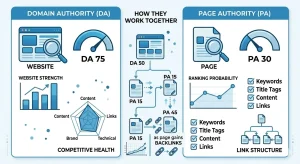
Many beginners confuse Domain Authority with another Moz metric called Page Authority (PA).
What Page Authority Measures?
Page Authority predicts how likely a specific webpage is to rank in search results.
While Domain Authority evaluates the entire domain, Page Authority focuses on individual pages.
How Domain Authority and Page Authority Work Together?
Both metrics are related but serve different purposes.
Example:
| Metric | Measures |
| Domain Authority | Strength of the entire website |
| Page Authority | Strength of a single page |
A website might have DA 50, but a newly published article on that site might have PA 15.
Over time, as the article gains backlinks, its Page Authority increases.
When You Should Focus on Each Metric?
Domain Authority is useful for:
- analysing entire websites
- evaluating backlink opportunities
- comparing competitors
Page Authority is useful for:
- analysing individual pages
- optimising specific blog posts
- improving internal link structures
How Can I Increase the Domain Authority of My Website?
Although Domain Authority itself cannot be directly controlled, certain SEO practices can help improve it.
Build High-Quality Backlinks
Backlinks remain one of the most important signals affecting Domain Authority.
Effective ways to earn backlinks include:
- guest blogging
- digital PR campaigns
- industry collaborations
- resource link building
Quality is far more important than quantity when it comes to backlinks.
Improve Website Content and SEO Structure
Publishing helpful, informative content increases the chances of earning natural backlinks.
Important content factors include:
- strong keyword targeting
- well-structured headings
- clear explanations
- original insights
High-quality content naturally attracts attention from other websites.
Strengthen Internal Linking Strategy
Internal links help distribute authority throughout your website.
This improves:
- crawlability
- page indexing
- topical authority
A strong internal linking structure helps search engines understand your site better.
Remove Toxic or Spammy Links
Low-quality backlinks may weaken a website’s link profile.
Using SEO tools to identify harmful backlinks and disavow them can help maintain a healthy domain authority profile.
Common Misconceptions About Domain Authority
Several myths surround Domain Authority, especially among beginners.
Domain Authority Is Not a Google Ranking Factor
Google does not use the Moz Domain Authority metric.
However, many factors influencing DA, such as backlinks are also important ranking signals.
DA Score Does Not Increase Instantly
Domain Authority usually increases gradually as backlinks accumulate.
Significant improvements may take months of consistent SEO work.
Domain Authority Is Only a Comparative Metric
DA works best when comparing websites within the same industry.
Comparing a small blog with a global platform does not provide meaningful insights.
DA vs. Topical Authority: Which Matters More in 2026?
While checking a website’s DA is a great starting point, the SEO landscape has shifted. Today, Google prioritizes Topical Authority, which measures how deeply a website covers a specific subject.
In many cases, a “smaller” site with lower DA can outrank a “giant” site if it has better topical depth.
The Power of “Going Deep”
Imagine you are trying to rank for a competitive keyword like “Best Organic Fertilizers for Tomatoes.”
- Website A (The Generalist): A major news site with a DA of 75. They have one well-written article about gardening.
- Website B (The Specialist): A dedicated gardening blog with a DA of 30. They have 50 interconnected articles covering soil health, seed starting, tomato pests, and composting.
The 2026 Result: Website B will often rank higher. Even though its “Domain Authority” is lower, its Topical Authority is superior. Google’s AI systems (like Gemini and Search Generative Experience) recognize Website B as a niche expert and a more trustworthy source for that specific query.
How to use this for your strategy:
- Don’t be intimidated by high DA: If you see a high-DA site ranking for your target keyword but their content is broad or shallow, you can beat them by creating a “Topic Cluster” (multiple related posts) on your site.
- Stay in your lane: To build authority fast, avoid publishing random content. If your site is about “Crypto,” don’t post about “Cooking” just because the keyword is easy. It dilutes your topical signal.
- Check Relevance, not just Score: When looking for backlinks, a link from a DA 25 site in your exact niche is often more powerful than a link from a DA 60 site that is unrelated.
Conclusion: Why Checking Domain Authority Helps Your SEO Strategy
Understanding how to check DA of a website is an important skill for anyone involved in SEO, digital marketing, or website management.
Domain Authority provides a useful estimate of a website’s strength and helps compare websites within the same industry.
Although it is not a direct Google ranking factor, it can guide important SEO decisions such as:
- evaluating backlink opportunities
- analysing competitors
- tracking website growth
By consistently improving content quality and earning high-quality backlinks, websites can gradually strengthen their Domain Authority and overall online visibility.
Frequently Asked Questions
How can I check domain authority for free?
You can check domain authority using free tools such as Moz’s Domain Authority checker or Small SEO Tools. Simply enter the website URL to view the authority score.
How often does domain authority update?
Domain Authority updates periodically when Moz refreshes its backlink database. This typically occurs every few weeks.
Is domain authority a Google ranking factor?
No. Domain Authority is a third-party metric developed by Moz. Google uses its own internal ranking signals.
What is the difference between domain authority and domain rating?
Domain Authority is created by Moz, while Domain Rating is a metric developed by Ahrefs. Both measure backlink strength but use different algorithms.
Can a new website have high domain authority?
Most new websites start with a very low Domain Authority score because they have limited backlinks and domain history.
Does domain authority affect SEO rankings?
Domain Authority itself does not affect rankings directly, but the factors influencing it, such as backlinks, do impact SEO performance.
How long does it take to increase domain authority?
Increasing Domain Authority usually takes several months of consistent SEO work, including backlink building and content improvements.