

Referring domains and backlinks are often mentioned together in SEO discussions, but they represent two distinct measurements that search engines interpret differently. A backlink is an individual link pointing from one website to another, while a referring domain is the unique website that provides one or more of those links.
In simple terms, backlinks measure how many links a site receives, while referring domains measure how many different websites are linking to it. This distinction matters because modern search engines place strong emphasis on link diversity, trust, and natural patterns, not just raw link volume.
Understanding the difference between referring domains vs backlinks helps website owners avoid ineffective strategies and focus on long-term SEO growth rather than short-lived ranking boosts.
At a Glance: Backlinks vs. Referring Domains
| Metric | Definition | SEO Value |
| Backlink | An individual “vote” or link from one page to another. | High (Quantity + Quality) |
| Referring Domain | The unique website that provides the link(s). | Higher (Trust + Diversity) |
Key Takeaway: If a single website links to you 100 times, you have 100 backlinks but only 1 referring domain. For the best SEO results, focus on increasing your referring domains to show Google that multiple independent sources trust your content.
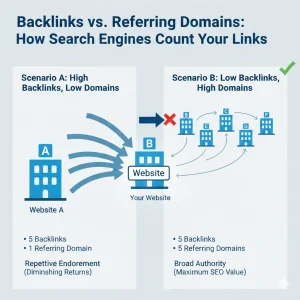
While Scenario A has the same number of links, Scenario B is more powerful for ranking because it shows trust from multiple unique sources.
What Is the Difference Between Referring Domains and Backlinks?
The difference lies in counting method and SEO meaning, not just terminology.
A website can receive hundreds of backlinks from a single source, but that still represents only one referring domain. Search engines see these two signals separately because they communicate different things about credibility and popularity.
Key Concept Comparison
| Metric | What It Measures | What It Signals to Search Engines |
| Backlinks | Total number of incoming links | Level of endorsement and citation |
| Referring Domains | Number of unique linking websites | Breadth of trust and authority |
| Multiple links from one site | Repetition | Limited additional trust |
| Links from many sites | Diversity | Stronger credibility |
From an SEO perspective, diversity usually carries more weight than repetition, especially when links are earned naturally.
The “First Link” Rule: What is Link Equity?
In SEO circles, this is often referred to as Link Juice. Think of a referring domain as a faucet.
- The First Link: When a website links to you for the first time, the faucet is wide open. You receive a significant transfer of authority (equity).
- Subsequent Links: If that same website links to you again in a different article, the faucet is narrowed. You still get some value and, more importantly, referral traffic, but the impact on your Search Engine Results Page (SERP) position is much smaller.
Why Search Engines do this: If every link from the same site carried equal weight, a webmaster could simply create 1,000 pages on one site and link to themselves to “cheat” the system. By prioritizing the referring domain (the source), Google ensures that rankings are based on broad consensus rather than repetitive self-promotion.
How We Filter for High-Value Referring Domains? (Case Study)
At ClickDo, we’ve analyzed thousands of link profiles. We’ve consistently found that sites focusing strictly on Referring Domain growth see a much steadier upward trend in organic traffic than those chasing raw backlink volume.
The Strategy: Quality over Quantity
When we use tools like Ahrefs or Semrush to audit a site, we don’t look at the “Total Backlinks” number. That number is often inflated by junk. Instead, we use this 2-step filter to find the “Gold” domains:
- Step 1: The Traffic Floor: We filter our referring domains to only show sites with at least 1,000+ monthly organic visitors. If a domain has no traffic from Google, its “vote” for your site is significantly weaker.
- Step 2: The DR/DA Trend: We look for domains where the Authority (DR or DA) is stable or growing. A link from a “dying” site (one losing traffic every month) passes very little long-term value.
The Result: In a recent internal test, we focused on acquiring just 5 high-quality, niche-relevant referring domains rather than 50 low-quality backlinks. Within 45 days, the target page moved from page 4 to the middle of page 1. Diversity and relevance beat volume every time.
What Are Backlinks in SEO and Why Do They Matter?
Backlinks are hyperlinks from external websites that point to a page on another website. They act as signals that content is useful, relevant, or worth referencing.
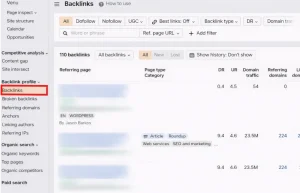
Search engines originally treated backlinks as votes. While algorithms have evolved significantly, backlinks still play a foundational role in determining page authority, relevance, and ranking potential.
How Backlinks Function as Ranking Signals?
When a reputable website links to another site, it suggests that the linked content contributes value to users. The strength of that signal depends on factors such as relevance, context, and authority of the linking site.
Backlinks embedded naturally within content tend to be more valuable than links placed in footers, sidebars, or unrelated pages.
Why Backlink Quality Matters More Than Quantity?
Not all backlinks contribute equally. A few editorial links from relevant, authoritative sources can outperform dozens of low-quality links from unrelated or spam-prone websites.
Search engines assess backlinks based on several qualitative factors rather than simple volume.
| Backlink Factor | SEO Impact |
| Relevance of linking site | High |
| Authority of domain | High |
| Contextual placement | High |
| Anchor text naturalness | Medium |
| Link location (content vs footer) | Medium |
| Paid or manipulative links | Negative |
Backlinks help SEO when they appear earned, relevant, and contextual, but they can lose value or even cause issues when acquired unnaturally.
What Are Referring Domains in SEO?
A referring domain is a unique website that links to another site at least once. Whether it links once or many times, it is still counted as a single referring domain.
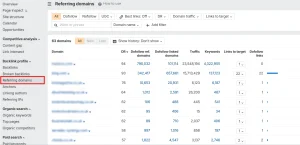
Referring domains provide search engines with insight into how widely trusted a website is across the web, not just how frequently it is mentioned by the same source.
Why Unique Referring Domains Carry Strong Weight?
When multiple independent websites link to the same page, it suggests consensus. This consensus is harder to manipulate and therefore more trustworthy in algorithmic evaluation.
Search engines favor patterns that indicate real popularity rather than artificial amplification.
Referring Domains vs Inbound Links Explained
| Term | Meaning |
| Inbound links | All links pointing to a site |
| Backlinks | Individual inbound links |
| Referring domains | Unique sources of inbound links |
While inbound links and backlinks focus on quantity, referring domains focus on source variety, which is critical for evaluating credibility.
Link Velocity: Why the Speed of Acquisition Matters?
It isn’t just about how many referring domains you have; it’s about how fast you are earning them. This is known as Link Velocity.
Search engines track the rate at which your referring domain count grows over time. This helps them distinguish between a site that is naturally growing in popularity and one that is trying to “game” the system.
The Three Types of Link Velocity
- Positive Link Velocity: Your referring domains are growing steadily every month. This signals to Google that your content is fresh and consistently useful. (Result: Rankings climb).
- Stable Link Velocity: You are gaining and losing links at the same rate. This is common for older, established pages. (Result: Rankings stay steady).
- Negative Link Velocity: You are losing referring domains faster than you are gaining them (often due to “link rot” or old sites closing down). (Result: Rankings may drop).
Warning for New Websites
Avoid “Link Spikes.” If a brand-new site goes from 0 to 500 referring domains in 48 hours, it triggers a red flag for “unnatural link building.” Modern SEO favors steady, organic growth over sudden bursts.
Referring Domains vs Backlinks: Which One Matters More for Rankings?
Both metrics matter, but they serve different evaluative purposes. In most competitive search environments, referring domains show a stronger correlation with ranking improvements than backlink count alone.
Link Quality vs Link Quantity
Search engines apply diminishing returns to repeated links from the same domain. The first few links from a trusted source may pass value, but additional links add less incremental benefit.
Referring domains help avoid this limitation by showing that many independent websites recognize the content’s value.
Authority, Trust, and Relevance in Link Evaluation
| Signal | Backlinks | Referring Domains |
| Depth of endorsement | Strong | Moderate |
| Breadth of trust | Limited | Strong |
| Manipulation resistance | Lower | Higher |
| Long-term SEO stability | Medium | High |
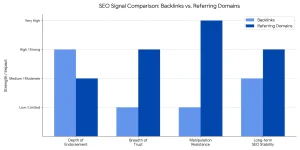
For sustainable rankings, search engines favor websites that attract links from many relevant domains, not just many links overall.
The Budgeting Matrix: Where Should You Invest Today?
Not every website needs the same strategy. Your “Search Intent” changes based on your site’s maturity. Use this matrix to decide where to allocate your SEO budget or time this month.
| Your Site Stage | Primary Focus | The Strategy |
| Brand New Site | 100% Referring Domains | You need “Broad Consensus.” Focus on getting 1 link each from 20 different sites rather than 20 links from one site. |
| Growing Site | 70% Domains / 30% Backlinks | Start deepening relationships. It is okay to get 2-3 links from a top-tier industry site while still hunting for new sources. |
| Established Authority | 50% Domains / 50% Backlinks | Focus on “Stability.” High-volume backlinks from existing partners help maintain your “moat” against competitors. |
Resource Allocation: The “Rule of Diminishing Returns”
If you have a limited budget, always buy/earn the first link from a new domain.
If you’re considering buying backlinks as part of your growth strategy, we’ve outlined the risks, evaluation criteria, and quality safeguards on our separate page so you can make an informed decision rather than focusing only on volume.
In terms of ROI, the value of a second or third link from the same domain is roughly 20-30% of the value of the first link. If a guest post on a new site costs $200 and a second post on an old site costs $200, the new site is almost always the better investment for pure ranking power.
The Exception: If the existing domain has massive Referral Traffic, the direct leads you get might outweigh the SEO “link juice” benefits. Always weigh the “Human Value” alongside the “Bot Value.”
How Referring Domains and Backlinks Work Together?
Strong SEO performance does not rely on choosing one metric over the other. Instead, it depends on a balanced relationship between referring domains and backlinks.
A healthy link profile typically includes multiple backlinks from each referring domain, spread naturally across different pages and topics.
Characteristics of a Natural Link Profile
| Indicator | Healthy Pattern |
| Growth speed | Gradual |
| Domain variety | Broad |
| Content relevance | High |
| Anchor text | Natural and mixed |
| Source type | Blogs, resources, publications |
Search engines expect links to reflect how people genuinely reference useful content over time.
Anchor Text Diversity: How Domains Talk About You?
If referring domains are the “who” and backlinks are the “what,” then Anchor Text is the “how.” This is the clickable text used in a hyperlink.
For your referring domains to carry maximum weight, your anchor text profile must be diverse. If every single referring domain links to you using the exact same phrase (e.g., “best budget running shoes”), Google may suspect a paid link scheme.
The Anatomy of a Natural Anchor Profile
To rank in the Top 3, your profile should be a mix of these four types:
- Branded Anchors: Using your website name (e.g., “According to [YourSiteName]…”). This builds brand authority.
- Naked URLs: The raw link (e.g., [suspicious link removed]). This is how many people naturally share links.
- Generic Anchors: Simple phrases like “click here,” “this study,” or “read more.” * LSI & Topic Anchors: Phrases related to your topic but not exact matches (e.g., “running gear tips” instead of your target keyword).
The “Over-Optimization” Trap
A common mistake for new websites is trying to force “Exact Match” keywords into every backlink. Modern SEO favors referring domains that link to you naturally. If your anchor text is too perfect, it loses its power. Aim for a profile where your Brand Name is the most common anchor text, not your primary keyword.
Real-Life SEO Example: One Domain vs Many Domains
Consider two competing websites in the same industry.
Website A receives 600 backlinks, but they come from only 6 referring domains.
Website B receives 180 backlinks from 75 different referring domains.
Despite having fewer backlinks, Website B is more likely to rank higher because it demonstrates:
- Broader industry recognition
- Lower manipulation risk
- More natural popularity signals
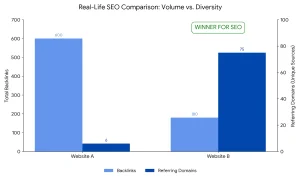
This example illustrates why focusing only on backlink numbers can lead to misleading conclusions about SEO strength.
What are the Common Misconceptions About Referring Domains and Backlinks?
Many SEO misunderstandings arise from outdated practices or oversimplified advice.
Confirmed Facts vs Misinformation
| Claim | Reality |
| More backlinks always improve rankings | False |
| One strong site linking repeatedly is enough | False |
| Referring domain diversity matters | True |
| Relevance is critical | True |
Search engines are designed to reward authentic authority, not artificial volume.
How to Analyze Referring Domains and Backlinks Properly?
Effective analysis looks beyond surface-level numbers.
A proper review considers where links come from, how they are placed, and whether they align with the website’s topic and audience.
Metrics That Provide Real Insight
| Metric | Why It Matters |
| Referring domain count | Measures trust breadth |
| Domain relevance | Prevents dilution |
| Authority distribution | Avoids reliance on few sites |
| Link context | Indicates editorial intent |
Warning signs include sudden spikes in backlinks from one source or large numbers of links from unrelated websites.
Agencies managing multiple client campaigns often require scalable systems for acquiring and tracking referring domains. On our white label link building services page, we break down how we handle domain vetting, anchor diversity, and link velocity management at scale.
What are the Best Practices for a Balanced Link Building Strategy?
Long-term SEO success comes from earning attention, not manufacturing links.
Websites that consistently publish useful, original, and well-researched content naturally attract referring domains over time. Outreach, partnerships, and digital PR can support this process when done ethically.
For businesses that prefer structured outreach rather than ad-hoc placements, our dedicated page on link building services explains how we secure niche-relevant referring domains with a focus on diversity, authority stability, and long-term ranking resilience.
Long-Term Benefits of Domain Diversity
| Benefit | Impact |
| Algorithm resilience | Higher |
| Ranking stability | Stronger |
| Brand credibility | Increased |
| Trust signals | More reliable |
Diverse referring domains protect websites from volatility caused by algorithm updates or link devaluations.
Beyond SEO: The Referral Traffic Factor
While we focus on referring domains for ranking power, we shouldn’t ignore the direct traffic value. A backlink is not just a “vote” for Google; it is a bridge for a human reader.
In 2026, Google’s algorithms are increasingly sophisticated at identifying “User Intent” and “Link Utility.” If a backlink is placed in a way that actually encourages users to click through, meaning it provides real value to the reader, that link carries a much stronger “relevance” signal than a hidden link in a footer.
The Hidden Benefits of High-Traffic Backlinks
- Social Proof: When users click a link from a trusted referring domain and stay on your site, it tells Google your content is high-quality.
- Secondary Link Building: Direct visitors who find your content via a referral often end up sharing it themselves, leading to new referring domains without any extra effort on your part.
- Conversion Potential: Referral traffic from a niche-relevant domain often converts at a higher rate than general search traffic because the “trust” has already been established by the linking site.
Expert Tip: One backlink from a medium-sized blog that sends 100 visitors a month is often more valuable for your business than a “Dofollow” link from a massive site that sends zero visitors.
Referring Domains vs Backlinks: Final Thoughts for Sustainable SEO
Referring domains and backlinks are complementary, not competing metrics. Backlinks show how deeply content is referenced, while referring domains show how widely it is trusted.
For sustainable SEO growth, websites should prioritize earning links from many relevant sources, supported by strong content and natural visibility. This approach aligns with how modern search engines evaluate authority and ensures long-term ranking stability rather than short-term gains.
FAQs
Are referring domains more important than backlinks?
Yes, in most cases. While backlinks provide the total volume of links, referring domains represent the breadth of your authority. Google treats links from 50 different websites as a much stronger signal of trust than 50 links from the same website.
Is it bad to have many backlinks from one referring domain?
No, it isn’t “bad” or a penalty risk (unless it’s spam), but it does offer diminishing returns. The first link from a site passes the most “link juice” (authority). Subsequent links from that same site are still useful for referral traffic but have a much smaller impact on your SEO rankings.
How many referring domains do I need to rank on Page 1?
There is no “magic number.” To find your target, analyze the top 3 competitors for your target keyword using a tool like Ahrefs or Semrush. If the average top-ranking page has 150 referring domains, that is your benchmark for competitiveness.
Do nofollow links count as referring domains?
Yes. A referring domain is simply the source of a link, regardless of the link’s attribute. While nofollow or sponsored links pass less “authority” than dofollow links, they are essential for a natural-looking link profile.
Can a high backlink count but low referring domain count hurt my SEO?
It won’t necessarily hurt you, but it acts as a “red flag” for manual review or algorithmic filters. If you have 10,000 backlinks from only 2 referring domains, Google may view this as a site-wide sidebar link or a paid placement rather than an organic endorsement.