


Competitor backlink analysis is a foundational SEO practice I use to systematically evaluate the external links pointing to competing domains within my niche. Rather than treating backlinks as isolated metrics, I approach them as signals of trust, authority, and topical relevance within a broader search ecosystem.
At its core, this process allows me to understand why certain competitors consistently outperform others in search rankings. By dissecting their backlink profiles, I gain visibility into the relationships, content strategies, and authority signals that influence their position in search results.
This is not a superficial exercise in counting links. It is a strategic analysis of link quality, contextual relevance, and acquisition patterns. When executed properly, competitor backlink analysis becomes a roadmap for building a stronger, more resilient SEO strategy grounded in real-world data.
Why Is Competitor Backlink Analysis Critical for SEO Performance?
In a competitive digital landscape, success in SEO rarely comes from isolated efforts. It is the result of understanding what already works and refining it with precision.
When I conduct competitor backlink analysis, I am effectively reverse-engineering the authority signals that search engines value within a specific niche. This enables me to identify not only where competitors are earning links, but also why those links exist.
This distinction is critical. A backlink is not valuable simply because it exists, but because of its context, relevance, and placement.
Through this process, I am able to:
- Identify authoritative domains that shape the competitive landscape
- Understand content formats that naturally attract backlinks
- Detect gaps in my own backlink profile
- Prioritize outreach efforts based on proven opportunities
Over time, this structured approach leads to a more efficient allocation of resources and a stronger return on SEO efforts. Instead of pursuing links indiscriminately, I focus on building meaningful connections that contribute to long-term authority.
What Tools Are Essential for Competitor Backlink Analysis?
To conduct backlink analysis at a professional level, I rely on a combination of industry-standard tools, each offering unique strengths in data collection and interpretation.
The platforms I consistently use include:
- Ahrefs
- SEMrush
- Moz
- Google Search Console
Each of these tools contributes a different layer of insight. Ahrefs provides one of the most extensive backlink databases, SEMrush excels in competitive comparison, and Moz offers accessible authority metrics that are useful for quick evaluations.
To maintain a broader perspective and stay updated with evolving tools, I also refer to curated resources such as:
- SEO Tools to check backlinks: https://www.clickdo.io/seo-tools-to-check-backlinks/
- best backlink monitoring tools: https://www.clickdo.io/backlink-monitoring-tools/
These resources allow me to benchmark tools against specific use cases, ensuring that my toolkit remains both efficient and adaptable.
2026 SEO Tool Comparison: Backlink Analysis Features
| Feature | Ahrefs | Semrush | Moz Pro |
| Backlink Index | 35 Trillion (Live) | 43 Trillion (Fresh + Historical) | 44.8 Trillion (Total) |
| Data Freshness | Real-time / Daily | Daily Updates | Weekly / On-Demand |
| Link Gap UX | Best-in-class (Link Intersect) | Advanced (Backlink Gap) | Basic Comparison |
| AI Insights | Brand Radar (AI Visibility) | AI-Driven Writing Assistant | Limited AI Features |
| Top Strength | Largest Live Backlink Index | Best All-in-One Marketing Suite | Most Accurate Spam Score |
How Backlinks Can Be Evaluated Using Professional SEO Tools?
When I begin analyzing a competitor’s backlink profile, I prioritize clarity and structure. Tools like the Ahrefs Backlink Checker serve as an accessible entry point, providing immediate visibility into key backlink metrics.
However, the true value lies not in the tool itself, but in how the data is interpreted.
Establishing the Analysis Framework
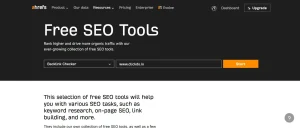
Before entering any URL, I define the objective of my analysis. This may include identifying link-building opportunities, evaluating authority gaps, or understanding content-driven link acquisition.
Having a clear objective ensures that the data I collect translates into actionable insights rather than passive observation.
Inputting and Segmenting Competitor Data
I begin by analyzing the competitor’s domain, followed by individual pages that rank for high-value keywords. This layered approach allows me to distinguish between overall domain authority and page-specific performance.
By segmenting the data in this way, I gain a more nuanced understanding of how backlinks contribute to rankings.
Interpreting Backlink Data with Context
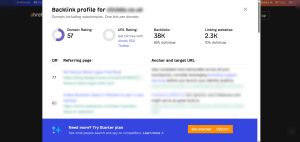
At this stage, I move beyond surface-level metrics and focus on contextual analysis.
I evaluate:
- The authority and relevance of referring domains
- The editorial context in which backlinks are placed
- The distribution of links across content types
- The naturalness of anchor text usage
This level of analysis enables me to identify patterns that are not immediately visible through raw data alone.
Translating Insights Into Strategic Actions
Once patterns emerge, I convert them into a structured action plan. This may involve creating content tailored to attract similar backlinks, initiating targeted outreach campaigns, or strengthening relationships with authoritative publishers.
The emphasis is always on improvement rather than imitation. My objective is not to replicate competitor strategies, but to refine and surpass them.
Validating Data Across Multiple Platforms
Given that no single tool provides a complete dataset, I cross-reference my findings using platforms such as:
- SEMrush
- Moz
This ensures that my analysis is both accurate and comprehensive, reducing the risk of overlooked opportunities.
A Real-World Snapshot of Backlink Strategy
In my years of managing SEO campaigns at ClickDo, I’ve learned that the most valuable insights aren’t found in the total “number” of links, but in the patterns of acquisition.
Recently, while auditing a client in the competitive London waste management niche, we were struggling to break into the Top 3. A standard Ahrefs scan showed our competitor had 3x our backlink volume. However, a deeper “Micro-Level” analysis revealed a specific gap:
- The Discovery: 60% of their highest-authority links weren’t coming from blogs or news sites. They were coming from local community sponsorship pages and sustainability resource lists hosted by UK councils.
- The Shift: We stopped focusing on generic guest posting. Instead, we pivoted our budget toward local London community initiatives and green-energy whitepapers.
- The Result: Within four months, we closed the “Authority Gap” and moved from position 12 to a stable #2 spot for our primary high-intent keywords.
Pro Tip: Don’t just copy every link a competitor has. If they have 1,000 low-quality directory links, ignore them. Focus on the top 5% of their profile that actually moves the needle—usually editorial mentions or niche-specific resource pages.
The Technical Workflow: A 3-Step Execution for 2026
Analyzing a competitor’s profile is a waste of time if you don’t know how to filter the “noise” from the “signals.” Here is the exact technical workflow I use to extract high-value opportunities in minutes.
1. The “Link Intersect” Discovery (Ahrefs/Semrush)
The most efficient way to find “easy wins” is to identify domains that link to 2 or 3 of your competitors, but not to you. If a site links to multiple players in your niche, they are highly likely to link to you as well.
- The Action: Open Ahrefs Link Intersect (or Semrush Backlink Gap).
- The Input: Enter the URLs of your top 3 ranking competitors in the “Show me who links to…” section.
- The Target: Enter your own domain in the “But doesn’t link to…” section.
- The Goal: Hit “Show link opportunities.” This generates a list of “warm” prospects who are already active in your industry.
2. Applying the “Quality First” Filter
A raw list of 5,000 links is a liability, not an asset. To rank in the top 3, you must filter for quality. I apply the following strict criteria to every list I pull:
- DR/DA 30+: Focus on sites with established authority.
- Traffic 1k+: In 2026, a link from a site with zero organic traffic is a major red flag. If Google doesn’t trust them enough to send them traffic, you don’t want their link.
- Dofollow Only: While Nofollow links have value for a natural profile, your primary ranking “juice” comes from Dofollow attributes.
- Language & Region: Filter to ensure the linking sites are relevant to your target market (e.g., .uk for London businesses).
3. Spotting “Ghost” Links & PBNs (The Context Filter)
One of the biggest mistakes I see is “blind replication”—copying a competitor’s link profile only to realize they are using a Private Blog Network (PBN) that will eventually trigger a manual penalty.
How to spot a “Ghost” link you should avoid:
- The “Sidebar” Test: Is the link hidden in a footer or a sidebar with 50 other unrelated links? (Ignore it).
- The “Out of Place” Content: Does a high-authority site about “Health” suddenly have an article about “London Rubbish Removal”? This is likely a paid guest post on a link farm.
- Traffic Trends: Check the referring domain’s traffic in Semrush. If you see a sharp, sudden drop to zero, the site has been penalized. Do not replicate these links.
How Competitor Backlinks Can Be Identified and Analyzed Systematically?
A structured and repeatable methodology is essential when approaching competitor backlink analysis at scale. Without a clear system, it becomes easy to get overwhelmed by large volumes of backlink data without extracting meaningful or actionable insights.
Identifying True SEO Competitors
I begin by identifying competitors based on actual search visibility rather than brand recognition. This distinction is critical because business competitors and SEO competitors are not always the same.
To do this, I analyze search engine results for my primary and secondary keywords. I look for domains that consistently appear across high-intent queries. These are the websites that search engines already consider authoritative within my niche.
By focusing on ranking competitors, I ensure that my backlink analysis is aligned with real search performance rather than assumptions.
Conducting Macro-Level Backlink Analysis
Once I have defined my competitors, I start with a macro-level evaluation of their backlink profiles.
At this level, I focus on understanding the overall strength and growth patterns of their backlinks. This includes:
- The number of referring domains
- The rate of link acquisition over time
- The overall authority distribution
This high-level analysis helps me identify whether a competitor’s SEO success is driven by consistent link building, strong content assets, or strategic partnerships.
Performing Micro-Level Backlink Evaluation
After gaining a broad overview, I move into a more detailed, page-level analysis.
Here, I examine individual backlinks to understand their quality and context. I focus on:
- The relevance of the linking website
- The placement of the link within the content
- The type of content attracting backlinks
- The anchor text being used
This level of analysis allows me to distinguish between high-value editorial backlinks and low-impact links that may not contribute significantly to rankings.
Using Link Gap Analysis to Identify Opportunities
Link gap analysis is one of the most effective techniques I use in this process.
By comparing my backlink profile with those of multiple competitors, I can identify domains that link to them but not to my website. These domains represent highly relevant opportunities because they are already linking within my niche.
I typically prioritize:
- Websites linking to multiple competitors
- Industry-specific blogs and publications
- Resource pages and curated lists
This ensures that I focus on opportunities with a higher likelihood of success.
What is Link Gap Analysis? Link Gap Analysis is a strategic SEO process used to identify domains that link to multiple competitors but do not yet link to your website. In 2026, this is considered the highest-ROI activity in link building because it targets prospects already proven to be interested in your specific niche.
Prioritizing Backlink Opportunities Strategically
Not all backlink opportunities carry equal value. Once I identify potential domains, I categorize them based on priority.
I evaluate each opportunity based on:
- Relevance to my niche
- Domain authority and trust
- Likelihood of securing a backlink
This allows me to allocate my time and resources efficiently rather than pursuing links randomly.
Building a Scalable and Repeatable Process
The ultimate goal of this structured approach is scalability. By following a consistent methodology, I can repeat the process across multiple campaigns, niches, or clients without compromising quality.
Over time, this system enables me to:
- Improve outreach efficiency
- Create more targeted content
- Build stronger backlink profiles
- Adapt quickly to changes in competitor strategies
This systematic approach transforms competitor backlink analysis from a one-time task into an ongoing strategic advantage.
What Is Link Gap Analysis and Why Does It Matter?
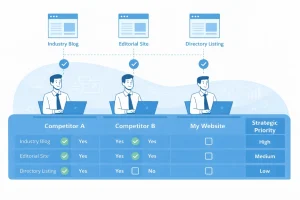
Link gap analysis is a targeted technique that enables me to identify backlinks my competitors have acquired but my website has not.
This process is particularly valuable because it highlights opportunities that are already validated within the niche.
| Element | Competitor A | Competitor B | My Website | Strategic Priority |
| Industry Blog | Yes | Yes | No | High |
| Editorial Site | Yes | No | No | Medium |
| Directory Listing | Yes | Yes | Yes | Low |
By structuring the data in this way, I can focus my outreach efforts on high-impact opportunities that are more likely to yield results.
How Competitor Backlinks Inform Strategic SEO Decisions?
Backlink data, when interpreted correctly, becomes a strategic asset rather than a static metric.
I use this data to guide decisions across multiple areas, including content development, outreach strategy, and authority building.
For instance, if I observe that competitors consistently earn backlinks from data-driven content, I prioritize the creation of research-based articles. If editorial mentions are prevalent, I focus on digital PR and relationship building.
This alignment between data and execution ensures that my SEO strategy remains both relevant and effective.
Competitor Backlink Analysis Framework
| Stage | Objective | Tools | Outcome |
| Identification | Define competitors | Ahrefs | Target domains |
| Evaluation | Analyze backlinks | SEMrush | Insight generation |
| Comparison | Identify gaps | Moz | Opportunity mapping |
| Validation | Assess quality | Multiple tools | Data accuracy |
| Execution | Outreach & content | CRM/Email tools | Link acquisition |
Is Competitor Backlink Analysis Ethical and Sustainable?
Competitor backlink analysis is a widely accepted and ethical practice within the SEO industry. It relies entirely on publicly accessible data and does not involve any form of unauthorized access.
When combined with ethical link-building practices, it supports sustainable growth and long-term search visibility.
The focus remains on creating value, building relationships, and earning links through merit rather than manipulation.
Conclusion
Competitor backlink analysis is not merely a tactical activity; it is a strategic discipline that underpins effective SEO.
By analyzing competitor backlinks with precision and intent, I gain insights that inform every aspect of my SEO strategy. This enables me to move beyond guesswork and operate with clarity, confidence, and consistency.
Over time, this approach leads to stronger authority, improved rankings, and sustainable organic growth.
Turning Insights into Authority: The ClickDo Advantage
Competitor backlink analysis is the compass of your SEO strategy, but the execution is the engine. As we’ve explored, ranking in the Top 3 in 2026 isn’t about matching a competitor’s link count; it’s about surpassing their link quality and topical relevance.
At ClickDo, we don’t just “build links.” We engineer digital authority. Our team of SEO specialists uses the exact frameworks detailed in this guide to help businesses bridge their authority gaps and dominate the SERPs.
Ready to stop guessing and start ranking? Don’t let your competitors own the conversation. Let our Link Building Experts perform a deep-dive audit of your niche and build a bespoke outreach roadmap for your brand.
Frequently Asked Questions
How often should backlink analysis be conducted?
I recommend conducting it regularly, ideally on a monthly or quarterly basis, depending on the competitiveness of the niche.
Are free backlink tools sufficient for analysis?
They provide a starting point, but professional-level analysis typically requires paid tools for deeper insights.
What makes a backlink valuable?
Relevance, authority, and contextual placement are the primary factors that determine backlink value.
Why do backlink data vary across tools?
Each tool uses its own crawler and database, which leads to differences in reported data.
Can backlink analysis guarantee higher rankings?
It provides the insights needed for improvement, but results depend on execution and consistency.
Is it necessary to analyze multiple competitors?
Yes, analyzing multiple competitors provides a more comprehensive view of the competitive landscape.
Does backlink analysis apply to all industries?
Yes, although the strategies and link sources may vary depending on the niche.

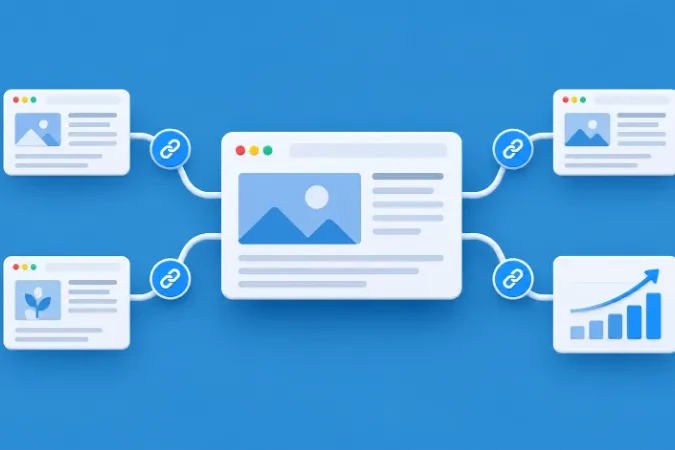


[…] a deeper analytical framework, ClickDo IO’s competitor backlink analysis guide explains how backlink profiles can be evaluated as part of a wider SEO […]