


Relevant backlinks are links from external websites whose topics, content or audiences are closely connected to your website.
They are valuable because they provide meaningful references for readers, help search engines discover related content and can support organic search visibility.
However, not every backlink from a high-authority website deserves an investment.
In our review of link-building practices, published SEO guidance and established outreach strategies, we found that backlink relevance needs to be evaluated at several levels.
The website’s niche matters, but so do the individual linking page, anchor text, reader intent, geographic market and editorial context.
For businesses investing in SEO, understanding these differences is essential. A relevant backlink can support a company’s authority and attract qualified visitors, while a poorly chosen placement may deliver little practical value.
This guide explains how we assess backlink relevance, identify worthwhile opportunities and build a strategy around quality rather than arbitrary link counts.
What Are Relevant Backlinks in SEO?
Relevant backlinks are incoming hyperlinks from websites or individual pages that share a meaningful connection with the content they reference.
For example, an accounting software company receiving a backlink from an article about small business bookkeeping has a clear topical connection.
A backlink from an unrelated entertainment article would generally have less contextual relevance, unless there is another legitimate reason for the reference.
Backlink relevance can take several forms:
- Topical relevance: The linking content discusses the same subject or a closely related subject.
- Industry relevance: The referring website operates within the same sector or business ecosystem.
- Audience relevance: Visitors to the linking website are likely to find the destination useful.
- Geographic relevance: The link connects businesses, publications or resources serving a particular location.
- Contextual relevance: The backlink appears naturally within content where it adds meaningful information.
The strongest opportunities frequently combine several of these characteristics.
Example of a Relevant Backlink
Consider a London-based digital marketing agency publishing a comprehensive resource about technical SEO.
A marketing publication publishes an article discussing website performance and includes a link to that technical SEO resource.
The link has a clear purpose: readers who want to understand technical SEO in greater detail can access additional information.
Now consider another backlink from a generic website publishing unrelated topics, including celebrity news, plumbing, cryptocurrencies and gardening.
Even if the second website has a higher Domain Rating, the marketing publication may represent the more useful opportunity.
This is why we evaluate the context of each backlink rather than relying entirely on website-level SEO metrics.
Why Are Relevant Backlinks Important for Google Rankings?
Backlinks have been part of Google’s approach to understanding relationships between web pages since its early development.
However, the value of a backlink cannot be determined solely by its existence.
Search engines can evaluate different signals when interpreting links, including the relationship between content, the linking page, anchor text and the quality of referring resources.
A relevant backlink can contribute to SEO in several ways.
1. Supporting topical understanding
When relevant industry publications reference a website’s content, those connections can help search engines understand the subjects associated with the website.
2. Supporting search visibility
Natural editorial links from useful pages can contribute to the signals search engines use when evaluating content.
3. Attracting qualified referral traffic
A backlink from a related publication may attract visitors who are already interested in the products, services or information being discussed.
4. Improving content discovery
Links allow users and search engine crawlers to move between connected resources.
5. Strengthening brand visibility
Being referenced by credible industry publications can introduce a company to relevant audiences, regardless of whether an individual link contributes measurable ranking value.
Our broader analysis of how link building helps SEO explains how backlinks fit alongside technical optimisation, content quality and long-term organic growth.
It is important to recognise that backlinks alone cannot guarantee better rankings. Search intent, content usefulness, competition and website quality continue to matter.
What Makes a Backlink Relevant?
We assess backlink relevance across several layers rather than making a decision from Domain Rating alone.
| Relevance factor | What we examine | Importance |
| Page relevance | Does the linking article closely match the destination topic? | Very high |
| Website relevance | Does the website regularly cover the subject? | High |
| Audience relevance | Would readers reasonably benefit from visiting the destination? | Very high |
| Editorial credibility | Is the content genuinely useful and independently maintained? | High |
| Contextual placement | Does the backlink fit naturally into the discussion? | High |
| Geographic relevance | Does the source serve the intended market? | Depends on campaign |
| Destination suitability | Does the target page fulfil the expectation created by the link? | High |
Page-Level Relevance
Page-level relevance is one of the first things we examine.
A large national publication may cover hundreds of topics. However, an individual article discussing business finance could be highly relevant to an accounting service.
Conversely, a specialist technology website might publish an unrelated lifestyle article. A backlink from that specific article may have limited relevance to technical SEO.
This distinction matters because domain-level categories do not tell the entire story.
Website-Level Relevance
We also investigate the referring website’s wider editorial focus.
An established industry publication with a consistent history of relevant content provides more context than a website that publishes unrelated sponsored material simply to accommodate backlinks.
Useful checks include editorial history, topical categories, identifiable authors, real readership and the quality of existing outbound links.
Audience and Search Intent
A backlink should ideally connect two pages that serve compatible reader needs.
For example, a blog discussing how restaurants manage online bookings could reasonably reference a reservation management software provider.
The industries are not identical, but the audiences and informational needs overlap.
This is an important consideration when assessing opportunities beyond narrowly defined niche websites.
How Do We Calculate Backlink Relevance?
To make prospect selection more consistent, we use a structured editorial scoring approach.
The following model allocates 100 possible points across seven criteria.
These percentages represent our recommended assessment weights. They are not Google’s ranking-factor weights or measurements of ranking impact.
Our 100-Point Backlink Relevance Framework
| Assessment criterion | Maximum score |
| Linking page topical alignment | 30% |
| Referring website niche alignment | 20% |
| Audience and search intent | 15% |
| Editorial credibility | 15% |
| Natural link placement | 10% |
| Geographic fit | 5% |
| Destination page suitability | 5% |
| Total | 100% |
We recommend assessing each prospective placement manually, using SEO tools for supporting evidence.
The resulting score is a prioritisation tool rather than a prediction of Google ranking improvements.
How to Interpret the Relevance Rating?
| Editorial rating | Assessment | Recommended action |
| 80–100% | Excellent relevance | Prioritise after quality and policy checks |
| 60–79% | Good relevance | Consider if the audience and editorial context fit |
| 40–59% | Limited relevance | Review carefully before spending resources |
| Below 40% | Poor relevance | Generally avoid for targeted outreach |
A website receiving 85% under this model is not guaranteed to produce 85% better rankings or traffic.
It simply performs strongly against our chosen selection criteria.
Example of Three Backlink Prospects
Suppose an SEO software company is evaluating three publications.
| Assessment | Specialist SEO blog | General business magazine | Unrelated content website |
| Page relevance /30 | 28 | 18 | 6 |
| Website relevance /20 | 18 | 13 | 4 |
| Audience fit /15 | 14 | 11 | 5 |
| Editorial credibility /15 | 13 | 9 | 7 |
| Link placement /10 | 9 | 8 | 4 |
| Geographic fit /5 | 4 | 3 | 3 |
| Destination fit /5 | 5 | 4 | 4 |
| Total relevance rating | 91% | 66% | 33% |
Illustrative scoring example, not an audit of actual websites.
The specialist SEO blog receives the highest rating because its content, readership and linking context are closely aligned.
The business magazine may still provide a useful opportunity, particularly when its article discusses digital marketing, software or business growth.
The unrelated website performs poorly because there is little convincing reason for its readers to follow the link.
This approach helps SEO teams explain why they select some placements and reject others, even when both websites have attractive authority metrics.
Are Niche Relevant Backlinks Better Than High-DR Backlinks?
Niche-relevant backlinks often deserve priority because they provide a clear topical connection between the referring website and the destination.
However, it would be inaccurate to say that niche relevance always outweighs every other quality signal.
Ahrefs Domain Rating and Moz Domain Authority are third-party metrics. They are useful for research, but they are not Google ranking scores.
Consider this hypothetical comparison:
| Factor | Website A | Website B |
| Domain Rating | DR 42 | DR 78 |
| Website type | Specialist SEO publication | Broad entertainment website |
| Linking article | Link-building strategy | General celebrity news |
| Audience fit | Strong | Weak |
| Contextual relevance | High | Low |
| Our editorial preference | First choice | Lower priority |
Website A may offer greater strategic value because its readers are more likely to be interested in SEO services.
Nevertheless, a relevant article on a trusted general-interest publication can also be valuable. The correct decision depends on the complete placement, not simply the website category.
Fernando Raymond, SEO Expert, has expressed this principle in his published approach to link acquisition:
“We focus on relevance and editorial quality over link volume.”
– Fernando Raymond, SEO Expert
We consider this an important distinction when planning campaigns. A website with impressive SEO metrics still needs to provide a credible, useful reason for linking to another resource.
How Can You Find Relevant Backlinks for Your Website?
Finding worthwhile opportunities requires a combination of competitor research, manual website assessment and targeted outreach.
We recommend beginning with the website’s existing backlink profile before contacting new publishers.
Step 1: Examine Existing Backlinks
Google Search Console provides a useful starting point for owners of verified websites.
Open Search Console, select the appropriate property and access the Links report.
Review:
- Top linked pages: Identify the pages already attracting external references.
- Top linking sites: Discover the domains that regularly link to your website.
- Top linking text: Examine how other websites describe your content.
- Internal links: See which important pages receive links from within the website.
The report is not a complete backlink database, but it provides valuable information about links Google has discovered.
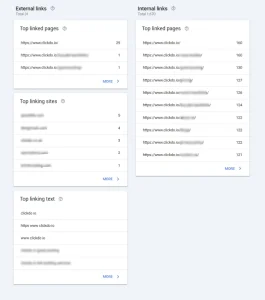
Google Search Console Links report showing the External links section, including Top linked pages, Top linking sites and Top linking text.
For a more extensive audit, our process for finding backlinks to a website explains how to combine Search Console with additional SEO research tools.
Step 2: Examine Competitor Backlink Profiles
Competitors can reveal relevant referring websites that have already demonstrated an interest in your industry.
Using Ahrefs Site Explorer, analyse competing domains or specific ranking pages.
Look at:
- Referring domains connected to the target topic.
- Articles that reference competitor resources.
- New and lost backlinks.
- Anchor text and surrounding content.
- Website traffic estimates and relevant ranking keywords.
- Potential editorial relationships or resource listings.
However, do not copy every competitor backlink.
Competitors may have links from irrelevant directories, outdated content or websites with questionable editorial practices.
Each opportunity must pass an independent relevance assessment.

Ahrefs Site Explorer backlink report showing referring pages, referring domains, Domain Rating and anchor text for a selected competitor.
Step 3: Use Backlink Gap Analysis
Backlink gap analysis identifies publications referencing competitors without linking to your website.
Ahrefs provides this through Competitive Analysis → Link Intersect.
Enter your website as the target and compare it against relevant competing domains or pages.
The resulting report can reveal publishers, directories and resource pages that may be suitable for outreach.

Ahrefs Link Intersect report identifying referring domains or pages linking to competitors but not to the target website.
We generally prioritise opportunities where multiple relevant competitors receive editorial references.
However, the fact that a website links to several competitors does not automatically mean it should link to every business in the industry.
The website still needs a reason to reference your content.
Step 4: Search for Relevant Publishing Opportunities
Manual research remains useful when SEO tools return large volumes of unsuitable prospects.
Google search operators can help narrow results.
| Search operator example | Intended purpose |
| “technical SEO” “resources” | Find relevant resource pages |
| intitle:”email marketing” “guide” | Identify articles about a target subject |
| “accounting software” “comparison” | Discover comparison content |
| site:example.com “SEO” | Find topic-related pages within one domain |
| “cybersecurity” “contribute” | Find possible editorial contribution pages |
These searches help discover potential publishers, but they do not guarantee that a website accepts contributions or link requests.
We recommend checking the site’s current editorial standards before making contact.
What Are the Best Ways to Build Relevant Backlinks?
The most sustainable opportunities usually arise when another website has a genuine editorial reason to reference a resource.
Different methods work better for different industries.
1. Create Linkable Research and Resources
Original research, useful tools, templates, statistics and genuinely comprehensive resources can attract natural editorial links.
For example, a cybersecurity company might publish an analysis of common security incidents affecting small businesses.
Technology journalists, security consultants and business publications could find the research worth referencing.
The content needs to provide information that is genuinely useful rather than simply repeating existing articles.
2. Contribute Expert Editorial Content
Relevant guest contributions can introduce specialists to new audiences.
An SEO consultant may write about website migrations for a digital marketing publication, while a financial software specialist may contribute an article about invoicing to a small business magazine.
The content should have independent editorial value.
Our approach to guest posting on relevant websites emphasises publisher selection, original content and natural placement.
Importantly, guest posting should not become a system of creating large numbers of low-value articles solely to manipulate search rankings.
3. Use Broken Link Building
Broken link building involves identifying a reference that no longer works and offering a suitable replacement.
For example, a marketing article might link to an outdated SEO checklist that now returns a 404 error.
If your website contains a current, genuinely equivalent resource, the publisher may consider replacing the broken reference.
This is particularly useful when there is a strong match between the missing information and your replacement content.
We explain the research and outreach process in our broken link building strategy, including how to identify suitable replacement resources.
4. Earn Local and Industry Citations
For local businesses, geographical relevance can be particularly useful.
A London accounting firm may reasonably benefit from references on professional association pages, local business resources, regional news publications and legitimate business directories.
A national technology company may prioritise relevant industry publications over local directories.
The key consideration is whether the listing helps users discover a genuine business or resource.
5. Reclaim Unlinked Brand Mentions
Sometimes publishers discuss a brand without linking to its website.
These mentions can create opportunities for a natural reference.
For example, a publication might mention a company’s research findings while omitting a link to the original report.
A respectful request asking the publisher to reference the underlying research could be appropriate.
However, editors are not obliged to add links, and brand mentions should not be treated as guaranteed backlink opportunities.
Which Link-Building Methods Deserve Priority?
We use the following qualitative ratings to compare common methods.
| Method | Editorial suitability rating | Best application |
| Original research and useful resources | 95% | Expertise-driven websites |
| Relevant digital PR | 90% | Brands with newsworthy insights |
| Broken link building | 85% | Educational resources |
| Unlinked brand mention outreach | 85% | Established brands |
| Carefully selected guest contributions | 80% | Professional and B2B industries |
| Legitimate niche directories | 70% | Local and specialist businesses |
| Generic directory submissions | 35% | Limited situations |
| Mass automated link placement | 5% | Not recommended |
These are illustrative editorial suitability ratings, not measured success rates or Google-approved scores.
In practice, suitability varies by campaign. A local business directory may be an excellent option for a specific location-based company, even if it receives a lower general rating than original research.
How Does Anchor Text Affect Backlink Relevance?
Anchor text is the clickable wording used within a hyperlink.
It provides contextual information about the destination and can help readers understand what they will find after clicking.
However, consistently using commercial exact-match anchors can create unnatural linking patterns, particularly when those links are deliberately manufactured.
| Anchor type | Example | Assessment |
| Branded | A company’s name | Natural where the brand is being referenced |
| Naked URL | example.com | Appropriate for some references and citations |
| Partial-match | Practical advice about backlink quality | Descriptive and contextual |
| Exact-match | Best SEO agency London | Can be legitimate, but repetitive manipulation creates risk |
| Generic | Read more | Useful in context, but less descriptive |
| Topical | Research on organic search performance | Useful when it accurately describes the destination |
We do not recommend a universal percentage split between anchor text categories.
A profile containing 70% branded anchors is not automatically safe, just as a profile with 20% exact-match anchors is not automatically unsafe.
The natural distribution depends on the business, the content attracting links and the reasons publishers reference it.
Our broader examination of do-follow links and link attributes discusses how anchor text, placement and link qualification affect backlink assessment.
Are Contextual Backlinks More Relevant Than Footer Links?
Contextual backlinks appear naturally within the main body of a page.
They are often useful because the surrounding information provides a clear explanation of why the destination is being referenced.
Consider an article explaining how businesses can reduce website loading times.
A link to a detailed technical resource about Core Web Vitals fits the reader’s immediate informational need.
A repeated sitewide footer link to an unrelated commercial page does not have the same contextual justification.
This does not mean every footer link is bad. Links to legitimate partners, associations, developers or corporate entities can serve real purposes.
The issue is whether the placement exists primarily to help users or to manipulate ranking signals.
When a backlink is relevant, its value may also support other pages through sensible internal linking.
For example, an educational resource that attracts links can direct readers to related service pages or more detailed articles.
Our analysis of how link juice works explains the concept of link equity and how website structure can help users navigate between connected resources.
How Can You Check Whether a Backlink Is High Quality?
Before pursuing a placement, we recommend assessing the actual referring page.
A high Domain Rating can be encouraging, but it does not replace manual verification.
Our Backlink Quality Checklist
| Question | Positive sign | Warning sign |
| Is the topic relevant? | Direct or meaningful adjacent relationship | No clear connection |
| Does the website have a genuine audience? | Evidence of readership and engagement | No identifiable audience |
| Is the linking article useful? | Original, informative content | Thin, repetitive material |
| Is the publisher credible? | Clear identity and editorial responsibility | Anonymous or misleading ownership |
| Are existing links natural? | References support the discussion | Repetitive commercial links |
| Does the website have topical consistency? | Recognisable editorial focus | Unrelated material published at scale |
| Is the linking page accessible? | Publicly available, useful content | Broken or inaccessible page |
| Is the backlink policy-compliant? | Genuine editorial reference or correctly qualified advertising | Paid ranking-credit link schemes |
Can Relevant Backlinks Still Be Harmful?
Yes. Topical relevance alone does not make a link-building practice compliant with Google policies.
A website selling contextual backlinks may publish relevant articles, but paid placements intended to pass ranking credit can still violate Google’s link spam rules.
Google distinguishes ordinary editorial links from advertisements and sponsored placements.
Paid promotional links should use appropriate attributes such as rel=”sponsored” or rel=”nofollow”.
Similarly, large-scale reciprocal linking, automated placements and low-value articles created primarily for links can present risks.
Businesses should review Google’s official spam policies before investing in outreach or paid publishing arrangements.
In my earlier discussion of link selection, I summarised the importance of publisher quality:
“A website does not need to be huge. It just needs to be real, relevant, and trustworthy.”
– Dinesh Kumar VM, Senior SEO Consultant
A smaller publication can be a legitimate and worthwhile reference source when it serves a real audience and maintains credible editorial standards.
Should You Disavow Irrelevant Backlinks?
Not automatically.
An irrelevant backlink is not necessarily evidence of manipulation. Natural backlink profiles often contain references from different topics and industries.
Google also states that most websites do not need to use its disavow tool because its systems can assess which links to trust.
Disavowing should generally be reserved for cases involving considerable artificial or spammy links that have caused, or are likely to cause, a manual action.
Removing potentially valuable links merely because a third-party tool labels them toxic can be counterproductive.
How Do Relevant Backlinks Work for Different Industries?
Different businesses need different combinations of topical, audience and geographic relevance.
| Industry | Suitable backlink sources | Strategic priority |
| SEO and digital marketing | Marketing publications, SaaS resources, specialist blogs | Topical authority |
| Finance and accounting | Accounting resources, business publications, professional organisations | Trust and sector relevance |
| Property | Property publications, local business organisations, housing resources | Geographic and industry relevance |
| Ecommerce | Product publications, relevant review sites, specialist retailers | Product and audience relevance |
| SaaS | Technology publications, integration partners, software resources | Technical and commercial relevance |
| Healthcare | Appropriate health publications, professional organisations, credible educational resources | Editorial quality and accuracy |
| Local services | Regional publications, legitimate directories, community resources | Local relevance |
We do not recommend forcing every campaign into the same publisher categories.
A local cleaning business may benefit from links associated with its service area, while an international software company may gain more from specialist publications serving users in multiple countries.
Likewise, a UK business does not need every backlink to come from a .co.uk domain.
Publisher audience, language, geographic coverage and relevance are more useful considerations than the domain extension alone.
How Much Should Businesses Invest in Relevant Link Building?
Link building costs vary according to the research required, the quality of content being produced and the effort involved in finding suitable publishers.
The correct budget should reflect the value of the target pages rather than a predetermined quantity of backlinks.
For example, an enterprise SaaS company with a high customer lifetime value may justify significant investment in expert research and digital PR.
A small local business may achieve more practical value through a modest campaign involving local partnerships, citations and useful content.
Before allocating a budget, we recommend evaluating:
- Commercial value: How valuable is the traffic or customer enquiry associated with the target page?
- Existing competition: How strong are the referring domains supporting competing pages?
- Content readiness: Does the destination provide enough value to deserve external references?
- Acquisition cost: How much work is required to create the asset and secure editorial attention?
- Risk exposure: Does the proposed approach comply with search engine policies?
- Measurable outcomes: Can the campaign generate relevant visits, brand exposure or business opportunities?
Spending more money does not automatically produce stronger backlinks.
The goal should be to make the campaign commercially sensible and editorially defensible.
How Can You Measure the Success of Relevant Backlinks?
We recommend measuring link-building performance beyond the number of backlinks acquired.
A useful campaign report should explain which content gained references, why those references matter and whether the website experienced meaningful changes over time.
Key Performance Indicators
| KPI | What it measures | Why it matters |
| Relevant referring domains | Number of distinct relevant domains | Shows diversity of external references |
| Editorial relevance rating | Quality of prospect-topic alignment | Supports placement selection |
| Organic clicks | Search traffic to target pages | Tracks search visibility outcomes |
| Keyword visibility | Positions and impressions for target queries | Provides directional evidence |
| Referral visits | Visitors arriving from linking sites | Measures direct audience value |
| Conversions | Enquiries, sign-ups or sales | Connects marketing to business results |
| Link retention | Whether references remain available | Monitors acquired placements |
| Link attributes | Followed, nofollow, sponsored or UGC | Helps assess link qualification |
Google Search Console provides useful search performance and linking information. Its officialLinks report documentation explains the data available to verified website owners.
How to Review Results Over 90 Days?
A 90-day review can provide a useful initial monitoring period, although ranking changes may take longer and cannot be attributed to backlinks alone.
| Period | Recommended activity | What to record |
| Days 1–30 | Audit and build the prospect list | Baseline performance and relevance scores |
| Days 31–60 | Publish resources and conduct outreach | Editorial responses and acquired references |
| Days 61–90 | Verify links and review performance | Referral traffic, impressions and conversion trends |
During the review, we also examine changes in content, internal linking, seasonality, competitors and search algorithms.
A ranking improvement after earning backlinks does not prove those backlinks were the sole cause.
For a more reliable assessment, compare similar pages or campaigns where possible and avoid attributing every positive movement to one link.
What Mistakes Should Businesses Avoid When Building Relevant Backlinks?
Several recurring mistakes can weaken a link-building strategy.
Prioritising Domain Rating over relevance
A high metric does not compensate for poor editorial context or a lack of genuine readership.
Treating every niche website as trustworthy
Some websites publish topical content primarily to sell links. Niche alignment alone is insufficient.
Relying on exact-match anchors
Repeated commercial keyword anchors across controlled placements can create manipulative patterns.
Targeting irrelevant destination pages
Even a strong publisher may offer limited value if readers arrive on a page that does not satisfy their expectations.
Confusing link counts with performance
More backlinks do not guarantee more organic traffic, leads or revenue.
Ignoring link attributes
Paid advertising and sponsorship arrangements require appropriate qualification.
Failing to review existing opportunities
Businesses sometimes invest in acquiring new links while overlooking broken references, unlinked mentions and useful resources they already own.
Our overview of link-building techniques covers additional acquisition approaches and the situations where they may be appropriate.
What Is Our Recommended Strategy for Building Relevant Backlinks in 2026?
Our preferred approach starts with the business outcome and works backwards to the websites most likely to provide worthwhile references.
First, identify the pages that deserve greater visibility. These may include original research, product resources, useful guides or commercial pages with clear informational value.
Next, understand the topics and audiences connected to those pages.
Research potential publishers, assess their relevance and evaluate their editorial standards.
Instead of assigning targets purely on authority metrics, rank prospects using a transparent scoring framework.
Develop an outreach proposition that explains why the destination is useful to the publisher’s audience.
Finally, track acquired references and assess their contribution to organic visibility, referral traffic and meaningful business outcomes.
We consider this more sustainable than buying links based on Domain Rating thresholds or pursuing volume without a clear editorial rationale.
Final Thoughts
Relevant backlinks should be assessed by the genuine relationship between the referring content, its readers and the destination website.
Our approach prioritises topical alignment, credible editorial standards, natural placement and measurable audience value.
A backlink does not become worthwhile simply because it appears on a high-DR website, contains a desirable keyword or comes from a recognised publication.
The strongest opportunities are those where readers have a clear reason to follow the link and the referring page provides meaningful context.
For businesses planning long-term SEO growth, the objective should be to earn references that deserve to exist, not simply increase the number of links in a backlink report.
Frequently Asked Questions
What Is a Good Relevance Score for Backlinks?
Under our editorial scoring model, 80% or above represents strong topical and audience alignment. This is an internal assessment benchmark, not an official Google measurement.
Can Irrelevant Backlinks Affect SEO Rankings?
Some irrelevant links are harmless. Links created as part of manipulative schemes may be ignored or contribute to manual actions, depending on the circumstances.
How Many Relevant Backlinks Does a Website Need?
There is no universal number. Requirements vary according to competition, content quality, existing authority and the strength of competing pages.
Are Relevant Backlinks Better Than High-Authority Backlinks?
A highly relevant editorial link can be more strategically useful than an unrelated high-DR placement. However, both relevance and credibility should be assessed.
Can You Get Relevant Backlinks for Free?
Yes. Original research, expert contributions, useful resources, unlinked mention outreach and genuine partnerships can earn backlinks without purchasing ranking-credit placements.
Do Nofollow Backlinks Have Any Value?
Yes. Nofollow links can still support referral traffic, brand exposure and content discovery. Google treats certain link attributes as hints rather than absolute ranking-credit rules.
How Long Does Relevant Link Building Take to Work?
There is no guaranteed timeframe. Discovery, indexing, competitive changes and other SEO factors all affect results. Businesses should measure outcomes over time rather than expecting immediate ranking improvements.