

Competitor backlinks can reveal some of the most useful link-building opportunities available in your market. Instead of starting a backlink campaign with a blank spreadsheet and trying to guess which websites may be willing to link to you, competitor backlink research shows which publications, blogs, directories, resource pages and industry websites are already linking to businesses competing for the same search visibility.
That makes competitor research useful for one simple reason: the link opportunity has already been demonstrated.
If a respected industry publication links to two or three websites competing with yours, there may be a legitimate reason for it to reference your business as well.
However, the objective should not be to copy every competitor backlink.
A competitor may have thousands or even millions of backlinks. Many may be irrelevant, automatically generated, outdated, impossible to replicate or simply not worth pursuing.
Successful competitor backlink research therefore asks deeper questions:
- Who is linking to competitors?
- Which competitors should actually be analysed?
- What pages are attracting those links?
- Why did the linking website reference them?
- Which websites link to several competitors but not you?
- Which links could realistically be earned?
- Which backlink opportunities should be ignored?
- What content or relationship would you need to earn the link?
This guide explains how to check competitor backlinks, how to find realistic opportunities and how to turn backlink data into an actionable SEO strategy.
What Are Competitor Backlinks?
Competitor backlinks are external links pointing from other websites to websites that compete with yours in organic search.
Suppose your business sells accounting software.
Several websites consistently outrank you for searches such as:
- accounting software for small businesses
- online bookkeeping software
- invoicing software
- accounting tools
- business expense software
The websites linking to those competing pages form part of their backlink profiles.
Analysing those backlinks can reveal websites that might also be relevant to your business.
These could include:
- Industry publications
- Business blogs
- Software review websites
- Comparison pages
- Resource pages
- News publications
- Trade associations
- Professional organisations
- Directories
- Partner websites
- Podcast websites
- Universities
- Research organisations
- Guest post publications
- Journalists
- Niche communities
The backlink itself is only the starting point.
The real value comes from determining why the link exists and whether the same opportunity applies to you.
For a deeper analytical framework, ClickDo IO’s competitor backlink analysis guide explains how backlink profiles can be evaluated as part of a wider SEO strategy.
Why Should You Check Competitor Backlinks?
Finding websites willing to provide legitimate backlinks is one of the hardest parts of link building. You could manually research hundreds of publishers, send outreach emails and discover that most of them never link to businesses in your industry.
Competitor backlinks reduce some of that uncertainty. A website already linking to one of your competitors has demonstrated at least some interest in your market, subject or type of content.
If the website links to several competitors, that signal becomes even more interesting.
Competitor backlink research can help uncover:
Websites Already Linking Within Your Industry
A marketing publication linking to several SEO companies clearly understands the SEO sector.
A financial publication linking to multiple accounting platforms already publishes content relevant to accounting software.
This does not guarantee a backlink.
It simply makes the website a more logical prospect than an unrelated publication selected solely because it has an impressive authority metric.
Content That Naturally Attracts Links
Competitor analysis can reveal whether backlinks are going primarily to:
- Research
- Statistics
- Free tools
- Calculators
- Templates
- Guides
- Surveys
- Original data
- Product pages
- Category pages
- News stories
- Glossaries
- Case studies
- Comparison pages
If competitors repeatedly earn links to one particular type of content, that pattern may indicate what publishers in the market actually want to reference.
Backlink Gaps
A backlink gap occurs when websites link to competitors but do not currently link to you.
This is particularly valuable when one referring domain links to several relevant competitors.
ClickDo IO’s detailed guide to backlink gap analysis explains how these missing referring domains can be identified and prioritised.
Competitor Link-Building Strategies
Individual backlinks can reveal tactics.
For example, a competitor’s backlink profile may show significant links coming from:
- Guest articles
- Digital PR
- Podcasts
- Product reviews
- Expert commentary
- Statistics
- Directories
- Partnerships
- Sponsorships
- Resource pages
- Broken-link replacements
Instead of asking only where did they get the link?, ask:
What did they do to deserve or acquire it?
That question usually produces much more useful information.
Business Competitors and SEO Competitors Are Not Always the Same
One of the most common mistakes when people check competitor backlinks is analysing only businesses they already recognise.
Your biggest commercial competitor may not be your biggest search competitor.
Suppose you run a specialist CRM platform.
You may compete commercially with several large software companies.
But when you search the keywords important to your business, the websites outranking you may include:
- SaaS blogs
- Software review websites
- Comparison platforms
- Marketing publications
- Smaller specialist CRM companies
- Technology publications
Those websites are competing for search visibility even if they do not sell exactly the same product.
That distinction matters.
- Commercial Competitor: A company competing for the same customers.
- SEO Competitor: A website competing for the same search terms and organic visibility.
- Page-Level Competitor: A particular page competing against one of your URLs for a specific keyword.
For competitor backlink research, all three can provide useful information.
How to Find Your Real Backlink Competitors?

Start with the search results.
Identify the keywords most important to the page or website you want to improve.
Search those keywords and record the websites repeatedly appearing near the top of the organic results.
Do this across multiple relevant queries.
You may discover that the same five or six domains repeatedly appear.
Those are strong candidates for competitor backlink research.
Do not automatically analyse enormous websites merely because one of their pages ranks.
Ask whether the competing page covers the same search intent and whether its backlink profile could realistically reveal opportunities relevant to your business.
How Many Competitors Should You Analyse?
For most backlink campaigns, beginning with approximately three to five relevant competitors produces enough data to identify useful patterns without creating an unnecessarily large dataset.
However, there is no universal number.
A specialist B2B market may have only a few genuine organic competitors.
A competitive software, finance, gambling or ecommerce sector may require a wider sample.
The objective is not to collect as many competitors as possible.
It is to identify a useful comparison group.
Look for websites that:
- Rank for your important keywords
- Target a similar audience
- Publish related content
- Compete for similar search intent
- Have established backlink profiles
Once these competitors have been selected, you can start finding the actual links.
How to Check Competitor Backlinks?
There are several SEO platforms that can analyse websites you do not own.
Unlike Google Search Console, which is primarily useful for verified websites you control, third-party backlink databases allow you to research competing domains.
Common backlink research tools include:
- Ahrefs
- Semrush
- Moz
- Majestic
- SE Ranking
- Ubersuggest
The exact interface varies, but the underlying process remains similar.
ClickDo IO has compared the major platforms in its guide to the best backlink checker tools if you need to choose an appropriate platform.
Step 1: Enter the Competitor Domain
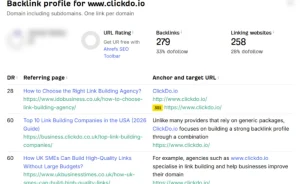
Start with one competitor.
Analyse either:
- The entire domain
- A subdomain
- A directory
- An exact page
Which option you choose depends on the objective.
If you want to understand the competitor’s overall link strategy, analyse the domain.
If you want backlinks relevant to one specific page you are trying to outrank, analyse the exact competing URL.
Step 2: Review Referring Domains
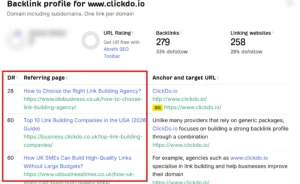
Do not immediately concentrate on total backlinks.
A competitor might have 100,000 backlinks but only 4,000 referring domains because individual websites link repeatedly.
Referring domains often provide a clearer starting point for prospect research.
Look for websites that appear:
- Relevant
- Editorially legitimate
- Active
- Topically aligned
- Capable of sending genuine traffic
Step 3: Find the Exact Linking Page
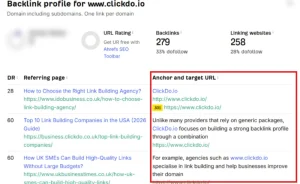
A domain-level metric does not explain why the backlink exists.
Open the actual page containing the competitor backlink.
Read the surrounding content.
Determine:
- Why the competitor was referenced
- Where the link appears
- What anchor text is used
- Which competitor page receives the link
- Whether the backlink is editorial, sponsored or user-generated
- Whether you could reasonably earn a similar reference
This is one of the most important stages of the process.
Find Competitor Backlinks by Understanding Why They Exist
Every useful competitor backlink normally has a reason.
Classifying that reason makes the opportunity much easier to understand.
1. Editorial Reference
A writer references the competitor because its page provides useful supporting information.
Possible response:
Create a more useful resource and introduce it to relevant writers.
2. Guest Post
The competitor contributed content to another website.
Possible response:
Determine whether the publication accepts expert contributions and propose a genuinely relevant article.
ClickDo IO provides managed guest posting services for businesses that want help securing relevant editorial placements.
3. Statistics or Research
A journalist references data published by the competitor.
Possible response:
Publish original research, statistics or an updated dataset.
4. Expert Quote
A company founder or specialist has been quoted in an article.
Possible response:
Build relationships with journalists and make knowledgeable people within your organisation available for commentary.
5. Directory Listing
The competitor appears within a relevant business or industry directory.
Possible response:
Determine whether your company meets the directory’s legitimate listing requirements.
6. Product Review
A blogger or publication has reviewed the competitor’s product.
Possible response:
Identify relevant reviewers and offer legitimate access to your product.
7. Resource Page
A useful competitor guide appears within a curated list of resources.
Possible response:
Create something that deserves to appear alongside or instead of the existing resource.
8. Partnership
A commercial, technology or industry partner references the competitor.
Possible response:
Look at your existing business relationships and determine whether any naturally justify an online reference.
9. Broken-Link Opportunity
A referring page links to competitor content that has disappeared or moved.
Possible response:
If you have a genuinely suitable replacement resource, contact the website and show exactly where the broken reference occurs. The most effective backlink strategy depends on why the original link was created.
How to Find Competitor Backlinks You Are Missing?
Looking at one competitor at a time can reveal hundreds of links.
Comparing several competitors simultaneously is usually more valuable.
This is commonly known as backlink gap or link intersect analysis.
Imagine five websites compete in the same market.
A particular industry publication links to four of them but not you.
That domain immediately deserves investigation.
It has demonstrated repeated willingness to reference businesses or resources within your subject area.
A backlink gap report can help identify:
- Domains linking to all competitors
- Domains linking to several competitors
- Domains linking to only one competitor
- Websites linking to competitors but not your site
Prioritise the overlap.
A website linking naturally to three competitors may represent a more obvious opportunity than a random domain linking once to a single competitor.
But again, open the actual pages.
Never assume that every gap should be filled.
How to Evaluate a Competitor Backlink?
Finding a backlink is easy.
Deciding whether it is worth pursuing requires considerably more judgement.
Use multiple signals.
| Factor | What to Check | Why It Matters |
| Topical relevance | Is the publication connected to your subject? | Supports contextual relevance |
| Page relevance | Does the linking article relate naturally to your page? | Makes the backlink logical |
| Organic visibility | Does the website attract genuine search visibility? | Helps identify active sites |
| Editorial standards | Is content written for real readers? | Filters low-value publishers |
| Link context | Why was the competitor referenced? | Reveals whether the opportunity is replicable |
| Outbound links | Does the site link naturally or excessively? | Can expose obvious link-selling patterns |
| Audience | Could relevant people actually encounter the link? | Adds referral and brand value |
| Geography | Does the publisher reach your market? | Important for regional campaigns |
| Anchor text | Does the wording appear natural? | Helps avoid over-optimisation |
| Link longevity | Is the page likely to remain available? | Protects long-term value |
Third-party authority scores can help with filtering.
They should not make the entire decision.
A smaller specialist publication with genuine readership may be more useful than a high-metric website publishing unrelated paid content across dozens of industries.
Do Not Copy Every Backlink Competitors Have
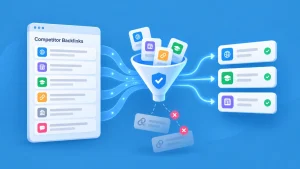
Competitor analysis is intelligence gathering.
It is not an instruction manual.
Competitor backlink profiles often contain links from:
- Scraper sites
- Spam directories
- Automatically generated pages
- Syndicated content
- Historic websites
- Foreign-language pages
- Low-quality blogs
- User profiles
- Forum spam
- Irrelevant websites
- Website templates
- Sitewide links
- Expired domains
Some may have existed for years without being intentionally built by the competitor.
Others may contribute little or no meaningful value.
Before attempting to copy a backlink, ask:
Would we genuinely want our brand mentioned on this website if SEO metrics were hidden?
That question removes a surprising number of poor prospects.
If you encounter questionable referring domains during the process, ClickDo IO’s guide explaining how to find toxic backlinks provides additional checks for suspicious link patterns.
Check Competitor Backlinks at Page Level
Domain-wide research shows the overall strategy.
Page-level research shows what is working for a particular search result.
Suppose your page targets:
project management software for agencies
Instead of analysing every backlink pointing to the competitors’ entire websites, take the URLs ranking above your page and examine links pointing specifically to those URLs.
This can reveal whether top-ranking pages have attracted links because of:
- Original statistics
- Comparison tables
- Free templates
- Industry research
- Useful tools
- Detailed explanations
- Unique data
- Strong brand awareness
Page-level competitor backlinks can therefore help guide both link building and content improvement.
Look at Competitor Pages With the Most Backlinks
Another useful tactic is to sort a competitor’s pages by referring domains.
This tells you which content attracts links naturally.
You may discover patterns such as:
- Statistics pages earning hundreds of referring domains
- Free calculators attracting links from educational websites
- Research reports generating news coverage
- Original surveys gaining journalist references
- Detailed industry guides being cited by bloggers
- Free templates appearing on resource pages
This information can influence your content strategy.
Instead of producing another generic blog post, you can create a resource that fills a demonstrated demand for reference-worthy information.
Analyse Competitor Anchor Text
Anchor text can provide additional clues about how competitors are earning backlinks.
Common anchor types include:
- Brand name
- URL
- Article title
- Product name
- Partial-topic wording
- Commercial keywords
- Generic phrases
- Natural sentence fragments
Repeated branded anchors often indicate genuine editorial references or company mentions.
Article-title anchors may indicate resources being cited.
Commercial exact-match anchors appearing repeatedly across low-quality websites deserve more scrutiny.
Do not create artificial anchor percentages simply because a competitor uses them.
Anchor text should make sense within the actual sentence and page.
For a deeper explanation of how authority can pass through links, see ClickDo IO’s guide to link juice and link equity.
Find Competitor Guest Post Backlinks
Competitor profiles can expose publications that accept industry contributors.
Look for articles where:
- The competitor is listed as author
- An employee wrote the article
- A company bio appears at the bottom
- The backlink appears naturally inside contributed content
Then investigate the publication.
Check whether it:
- Regularly publishes external contributors
- Covers your industry
- Has clear editorial standards
- Reaches a suitable audience
- Publishes original content
- Maintains active organic visibility
Do not simply recreate the competitor’s article.
Pitch something appropriate to the publication’s current audience.
Find Digital PR Opportunities
Competitor backlinks can also expose active PR strategies.
Suppose a competitor suddenly earns links from:
- National media
- Industry publications
- Regional news sites
- Specialist magazines
Open those articles and identify the common source.
Perhaps the company published:
- A survey
- New industry data
- Consumer research
- A market report
- A company study
- Expert predictions
- Proprietary statistics
One original dataset may be responsible for dozens of referring domains.
The correct response is not necessarily to approach each journalist individually asking for a backlink.
The better strategy might be to create original research worthy of coverage.
Find Resource-Page Opportunities
Some websites maintain curated resource pages for readers.
Examples include:
- Recommended software
- Industry tools
- Business resources
- Learning materials
- Research databases
- Professional organisations
- Useful calculators
- Templates
If several competitors appear on one of these pages, investigate why. Ask whether your website provides something equally useful. If it does not, create the missing resource before conducting outreach.
Use Competitor Backlinks to Improve Your Content Strategy
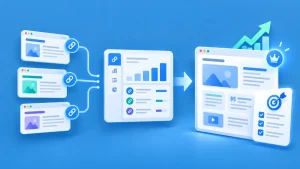
Competitor link analysis is not only an off-page SEO activity.
It can reveal what kinds of content people actually cite.
Suppose your competitor’s normal blog articles attract almost no links, while its statistics pages attract hundreds.
That tells you something.
Or perhaps product pages rarely earn backlinks but free templates consistently attract them.
Again, that is useful intelligence.
Use this information to build content with genuine citation value.
Potential linkable assets include:
- Original research
- Industry statistics
- Calculators
- Templates
- Free tools
- Databases
- Surveys
- Maps
- Benchmarks
- Glossaries
- Market reports
- Historical datasets
- Detailed comparison resources
Once those assets earn backlinks, internal linking can help distribute authority towards relevant supporting and commercial pages.
A Practical Competitor Backlink Workflow
Competitor backlink research works best as a repeatable system.
Stage 1: Select the Target
Decide what you want to improve.
This could be:
- Overall domain authority
- One important commercial page
- A content hub
- A product category
- A local landing page
- A new market
- A specific keyword cluster
Stage 2: Identify Search Competitors
Find the websites consistently ranking for the same queries.
Include page-level competitors where appropriate.
Stage 3: Check Their Backlinks
Use your backlink platform to export referring domains, backlinks and linked pages.
ClickDo IO’s guide explaining how to find backlinks for a site covers the underlying backlink research process in greater detail.
Stage 4: Run a Backlink Gap
Compare several competitors against your domain.
Prioritise websites linking to multiple relevant competitors.
Stage 5: Inspect Every Important Prospect
Open the referring page.
Understand the context.
Do not make decisions based solely on spreadsheet metrics.
Stage 6: Classify the Opportunity
Label each prospect according to its likely acquisition method:
- Guest post
- Digital PR
- Resource page
- Expert commentary
- Directory
- Partnership
- Review
- Broken link
- Linkable asset
- Existing relationship
Stage 7: Qualify the Website
Evaluate:
- Relevance
- Organic visibility
- Editorial quality
- Outbound-link behaviour
- Audience
- Page context
- Replicability
Stage 8: Create the Required Asset
Some opportunities require content before outreach.
You may need:
- Better research
- Updated statistics
- A stronger guide
- A free tool
- An expert quote
- Original data
- A genuinely useful article
Stage 9: Personalise Outreach
Explain:
- Why you selected the publication
- Where the opportunity exists
- What you are offering
- Why it benefits their audience
- Why your suggested resource fits
Do not send the same generic email to every prospect.
Stage 10: Track Results
Record:
- Referring domain
- Referring URL
- Target URL
- Anchor text
- Opportunity type
- Contact information
- Outreach status
- Publication date
- Link attribute
- Notes
- Lost-link status
A structured process turns competitor research into an actual link-building pipeline.
How Often Should You Check Competitor Backlinks?
Competitor backlink analysis should not be treated as a one-time activity.
Backlink profiles constantly change.
Competitors may:
- Launch new PR campaigns
- Publish new research
- Enter partnerships
- Gain editorial coverage
- Lose important backlinks
- Release tools
- Expand into new markets
- Start new content campaigns
Checking periodically allows you to identify these changes.
The correct frequency depends on your market.
Highly competitive industries may justify more frequent monitoring.
Smaller or slower-moving markets may not.
The goal is to identify meaningful changes rather than obsessively monitoring every individual backlink.
Competitor Backlinks Should Support a Wider Link-Building Strategy
Competitor research is powerful, but it should not become your entire strategy.
If every backlink you build comes from websites already linking to competitors, you are mostly following the market rather than creating something distinctive.
Combine competitor intelligence with other techniques.
ClickDo IO’s guide to link-building techniques covers additional strategies that can complement competitor research.
These may include:
- Digital PR
- Guest posting
- Original research
- Expert commentary
- Broken link building
- Brand mention reclamation
- Partnerships
- Linkable assets
Competitor backlinks tell you where opportunities already exist.
Original campaigns can create opportunities competitors do not yet have.
Should You Try to Match a Competitor’s Backlink Count?
Not necessarily.
Raw backlink counts can be misleading.
One competitor may have:
150,000 backlinks from 2,000 domains
while another has:
25,000 backlinks from 6,000 domains
Those profiles are very different.
Even referring-domain counts alone do not explain quality.
A better comparison considers:
- Relevant referring domains
- Editorial links
- Links to equivalent pages
- Authority distribution
- Link growth
- Content attracting links
- Geographic relevance
- Link diversity
The objective is not to reproduce a competitor’s backlink profile link for link.
It is to understand the competitive authority gap.
What If a Competitor Has More Backlinks but You Still Rank Higher?
Backlinks are only one part of SEO.
A website with fewer links may outperform a competitor because it has:
- Better content
- Stronger search-intent alignment
- Better internal linking
- Better technical SEO
- Higher topical relevance
- Stronger page-level links
- Better site architecture
- More useful information
- Better user experience
ClickDo IO’s explanation of how link building helps SEO explores how backlinks work alongside the wider optimisation process.
Backlink totals should therefore be interpreted as competitive evidence rather than a guaranteed ranking formula.
Common Competitor Backlink Analysis Mistakes
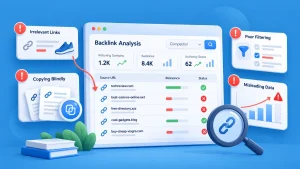
Several mistakes can dramatically reduce the usefulness of the process.
Choosing the Wrong Competitors
Do not analyse companies merely because they are famous.
Use websites actually competing for your search visibility.
Looking Only at Domain Metrics
DR, DA and similar metrics are useful shortcuts.
They do not replace reviewing the website and actual linking page.
Copying Everything
Some competitor links are weak, irrelevant or impossible to replicate.
Filter aggressively.
Ignoring the Linking Page
A strong domain can still contain an irrelevant or poor-quality backlink.
Context matters.
Ignoring Why the Link Exists
Knowing where a competitor earned a backlink is only half the research.
Understanding why it exists tells you what action to take.
Looking Only at DoFollow Links
Editorial nofollow links from highly credible publications can still provide brand visibility, referral traffic and future opportunities.
Treating Every Backlink Gap as an Outreach Target
Some gaps exist for legitimate reasons.
Perhaps your competitor sponsored an event, supplied research or maintains a business relationship you do not have.
Not every backlink can or should be replicated.
How ClickDo IO Approaches Competitor Backlinks?
At ClickDo IO, competitor backlink research is most useful when it moves beyond simply exporting link data. The objective is to turn competitive intelligence into practical link-building decisions.
That means understanding:
- Who is winning links
- Which pages attract them
- Why publishers are linking
- Which opportunities are realistically replicable
- What content needs to be created
- Which prospects deserve outreach
- Which links should be ignored
For companies that want help moving from analysis into acquisition, ClickDo IO provides link building services built around research, relevant publisher outreach and strategic link acquisition.
Competitor data should provide direction.
Human judgement determines which opportunities are actually worth pursuing.
Final Verdict: How Should You Use Competitor Backlinks?
Competitor backlinks are one of the clearest sources of link-building intelligence available.
They reveal which websites already reference businesses in your market, which content earns links, which publishers repeatedly cover the sector and where your backlink profile may be weaker than competing websites.
But simply exporting thousands of competitor links will not improve SEO.
The useful work begins after the export.
Identify the right competitors.
Check their referring domains.
Find websites linking to multiple competitors.
Open the actual linking pages.
Understand why every important backlink exists.
Then decide whether you can create a better resource, contribute useful content, supply original data, provide expert commentary or offer another legitimate reason for the publisher to reference you.
The strongest competitor backlink strategy is therefore not:
Find their backlinks and copy them.
It is:
Find what is working, understand why it works and use that intelligence to build something worth linking to.
That distinction turns competitor backlink analysis from a simple SEO-tool report into a repeatable link-building strategy.
Frequently Asked Questions
What are competitor backlinks?
Competitor backlinks are external links pointing to websites that compete with yours. Analysing them can reveal referring domains, publishers and link-building strategies already working within your market.
How do I check competitor backlinks?
Use a backlink analysis tool such as Ahrefs, Semrush, Moz, Majestic or SE Ranking. Enter the competing domain or exact URL and review its backlinks, referring domains, linked pages and anchor text.
How can I find competitor backlinks that my website does not have?
Run a backlink gap or link intersect analysis comparing your domain with several competitors. This reveals referring domains linking to competitors without currently linking to your website.
What is a backlink competitor?
A backlink competitor is a website whose backlink profile is useful for comparison with yours. The strongest candidates usually compete for similar keywords, audiences or search results.
How do I know which competitor backlinks are worth copying?
Check topical relevance, the actual linking page, editorial quality, organic visibility, audience relevance and the reason the competitor earned the link. Do not attempt to replicate every backlink.
Should I analyse domain-level or page-level competitors?
Use both. Domain analysis reveals broad link-building patterns, while page-level analysis is particularly useful when trying to understand why a specific competing URL outranks yours.
How many competitors should I check?
Three to five relevant competitors is often a useful starting point, although larger or highly competitive markets may justify analysing more.
Can competitor backlinks reveal guest post opportunities?
Yes. Competitor profiles can reveal publications where rival companies or their employees have contributed articles. Each site should still be manually reviewed for relevance and editorial quality.
What is the difference between competitor backlink analysis and backlink gap analysis?
Competitor backlink analysis investigates the overall links and strategies supporting competing websites. Backlink gap analysis specifically identifies referring domains linking to competitors but not your website.
Should I build every backlink my competitor has?
No. Competitor profiles contain strong links, weak links, irrelevant links and links that may be impossible to replicate. Each opportunity should be independently qualified.
Can competitor backlinks help with content ideas?
Yes. Looking at competitor pages with the most referring domains can reveal which formats attract citations, such as research, statistics, calculators, templates, tools and comprehensive guides.
How often should competitor backlinks be checked?
The appropriate frequency depends on how competitive and fast-moving your market is. Regular monitoring can reveal new campaigns, recently acquired links, lost links and emerging publishers.
Are competitor backlinks enough to improve rankings?
No. Backlinks work alongside content quality, technical SEO, internal linking, search intent, site architecture and other factors. Competitor research should therefore support a broader SEO strategy rather than operate in isolation.