

Backlinks benefits are often reduced to one simple claim: more backlinks can mean better Google rankings. That is true only when the links are worth having.
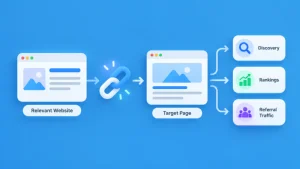
A relevant editorial backlink from a respected website can support rankings, help search engines discover pages, send qualified referral traffic and strengthen the wider authority of a website. Hundreds of irrelevant, automated or manipulative links may achieve none of those things.
That distinction is becoming more important.
When I assess a backlink profile, I rarely start by asking, “How many links does this website have?”
I look at who is linking, why they are linking, which page receives the link, the context around it, whether the source page is crawlable, and whether real users could reasonably benefit from following that link.
That is where the real importance of backlinks in SEO becomes clearer.
Google explicitly says it uses links as a signal when determining page relevance and also uses links to discover new pages to crawl. It additionally recommends descriptive, concise and relevant anchor text rather than forcing keywords into links.
Backlinks Benefits at a Glance
| Backlink benefit | What it can do | What determines the value |
| Better organic visibility | Support competitive rankings | Relevance, source quality and destination page |
| Link equity | Transfer some ranking value between pages | Strength of the linking page |
| Faster discovery | Give crawlers another route to a page | Crawlability and source-page visibility |
| Referral traffic | Send visitors directly to your site | Placement, readership and relevance |
| Topical credibility | Connect the website with authoritative niche sources | Context of the link |
| Brand exposure | Put your business in front of new audiences | Quality and reach of the publisher |
| Competitive strength | Help close authority gaps against ranking competitors | Quality of referring domains |
| Long-term SEO value | Continue providing traffic and visibility while the link remains live | Link stability and source quality |
The important word throughout that table is can.
A backlink is not automatically beneficial because it exists. Its value depends heavily on its source, context and purpose.
What Is a Backlink in SEO?
A backlink is a hyperlink from another website that points to a page on your website.
If an SEO publication writes about keyword research and links to one of your keyword research resources, your page has received a backlink.
It is an external link from the publisher’s perspective and an inbound link or backlink from your perspective.
Backlinks should also be separated from internal links.
An internal link connects two pages on the same domain. A backlink comes from another domain entirely.
Both matter for SEO, but they perform different jobs.
A useful way to understand the relationship is through link equity and link juice. Link equity describes the ranking value that can potentially move through links, while internal linking helps distribute that value through the receiving website.
ClickDo has a more detailed explanation of link equity and link juice for readers who want to understand how authority can move between pages.
Why Are Backlinks Important in SEO?
When people ask why are backlinks important in SEO, the answer should not stop at “Google likes backlinks.”
There are several separate mechanisms involved.
1. Backlinks Can Support Higher Search Rankings
Ranking improvement is the benefit most businesses want from link building. Google does not publish a simple equation where one backlink equals a certain ranking increase. Search rankings depend on numerous systems and signals.
Links nevertheless remain relevant. Google’s current link documentation states that links are used as a signal for determining the relevancy of pages.
Independent SEO studies also continue to find relationships between referring domains, backlinks and organic search performance, although correlation should never be treated as proof that links alone caused a ranking.
The important point is that links work alongside the rest of SEO.
Suppose two pages satisfy the same search intent, have comparable content quality and are both technically sound.
If one page has earned recommendations from several respected, relevant industry websites while the other has virtually no external recognition, those links can become an important differentiator.
This becomes particularly noticeable in competitive commercial SERPs.
It is one reason understanding how link building helps SEO is more useful than simply chasing a target number of backlinks.
2. Backlinks Help Search Engines Discover Pages
One backlink benefit that gets much less attention than rankings is discovery.
Search engines crawl the web by following links.
Google says the vast majority of new pages it discovers are found through links.
Imagine publishing a completely new resource.
You can include it in your XML sitemap and link to it internally. If external websites also begin linking to the resource, Googlebot gains additional pathways through which it can discover and revisit that URL.
That does not mean a backlink guarantees indexing.
Discovery, crawling, indexing and ranking are different processes.
But backlinks can make a page less isolated within the wider web.
3. Relevant Links Can Strengthen Topical Signals
This is where relevance becomes extremely important.
Consider two backlinks to an SEO agency.
The first comes from an established digital-marketing publication inside an article discussing technical SEO.
The second comes from an unrelated recipe site.
Even if both websites appear strong when viewed through third-party SEO metrics, the first link creates a much clearer contextual relationship.
The linking page, surrounding copy, anchor text and destination page all help establish what the relationship between the two resources actually is.
This is why I would generally choose relevance plus genuine editorial context over a random link selected only because a tool shows an impressive authority score.
4. Backlinks Can Send Qualified Referral Traffic
Not every backlink benefit needs Google in the middle.
People can click links.
That sounds obvious, but it gets forgotten when campaigns become obsessed with DR, DA, traffic graphs and backlink counts.
A link from a niche publication with an engaged audience can send prospective customers directly to your website.
For a business, that referral traffic may sometimes be more commercially useful than the theoretical ranking value of the backlink itself.
For example, a cybersecurity consultancy would probably gain more useful referral visitors from a respected cybersecurity publication than from a much broader entertainment site.
The right question therefore is not just:
“Will this link pass authority?”
It is also:
“Could the right person realistically click this link?”
If the answer is yes, the placement is already doing something useful independent of rankings.
5. Backlinks Can Build Recognition Outside Google
Good link building is also a distribution strategy.
Being referenced by publishers, bloggers, journalists, professional organisations, research sites and niche communities puts a business in places where new audiences can discover it.
A genuinely useful backlink can therefore create several outcomes from the same placement:
SEO value, referral traffic, brand exposure, professional credibility and possible future relationships with publishers.
That is why I would rather acquire one strong editorial mention that makes sense to a reader than dozens of anonymous links buried on pages nobody visits.
6. Backlinks Can Make Strong Content More Competitive
Backlinks cannot rescue every page. But they can help a page that is already good become more competitive. This distinction matters.
Suppose a page already:
- Answers the correct search intent
- Covers the subject comprehensively
- Loads properly
- Is indexable
- Has sensible internal links
- Demonstrates real expertise
- And provides something useful to searchers.
External links can then reinforce that page.
Trying to reverse the sequence, building links first and hoping they compensate for poor content—is far less reliable.
7. Backlinks Can Strengthen More Than the Page Receiving Them
This is one of the biggest missed opportunities I see in link building.
Suppose an original industry report attracts 30 strong backlinks.
Those links initially point to the report.
However, the report can also contain carefully chosen internal links to related guides, category pages or commercial pages.
That creates a route through which the authority entering the website can support its broader architecture.
This is why backlinks and internal linking should not be managed as completely separate disciplines.
A strong page that attracts links but has no useful internal connections is not making full use of the authority it has earned.
Does Every Backlink Provide the Same SEO Benefit?

No.
Two links can look identical in a backlink report while being completely different strategically.
What I Look for in a High-Quality Backlink?
| Factor | Stronger signal | Weaker signal |
| Topical relevance | Closely related website or page | Completely unrelated topic |
| Editorial reason | Link genuinely supports the article | Link appears inserted purely for SEO |
| Source quality | Real business, publisher or organisation | Thin or anonymous link site |
| Page quality | Useful, indexed content | Low-value generated page |
| Placement | Naturally inside relevant copy | Footer, sidebar or random author bio |
| Anchor text | Descriptive and natural | Repeated exact-match commercial keyword |
| Audience | Real readership | No meaningful users |
| Referring-domain diversity | Recognition from different credible sites | Hundreds of links from one weak source |
| Link stability | Evergreen or maintained content | Temporary or frequently deleted pages |
This is one reason raw backlink totals are dangerous.
A website reporting 20,000 backlinks is not automatically stronger than one reporting 500.
You have to investigate where those links actually come from.
Backlinks vs Referring Domains: Do Not Confuse the Two
This distinction is simple but extremely important.
A backlink is an individual link.
A referring domain is a unique website sending one or more backlinks.
If one website links to you 200 times, most backlink tools may report roughly 200 backlinks but only one referring domain.
If 50 different respected websites each link to you once, that gives you 50 backlinks from 50 referring domains.
Those profiles are not equivalent.
When evaluating the importance of backlinks in SEO, I therefore pay close attention to referring-domain quality and diversity, not merely total backlinks.
Anyone auditing an existing site can start by learning how to find backlinks for a website and then separate useful referring domains from repeated sitewide links, scraper links and low-quality placements.
Is One High-Quality Backlink Better Than 100 Weak Links?
Often, yes.
But I would avoid reducing backlink quality to a mathematical formula.
A single relevant link from a highly trusted publication can be significantly more useful than dozens of links from obscure directories or unrelated websites.
At the same time, one excellent backlink does not mean you should stop.
SEO benefits from building a natural pattern of credible references over time.
Quality and quantity are not really opponents.
The goal is to increase quantity without lowering the quality threshold.
Do Dofollow Backlinks Provide More Benefits?
Standard crawlable links do not require a special “dofollow” attribute. They are sometimes informally described by SEOs as dofollow links.
Other links can contain attributes such as nofollow, sponsored or ugc.
Google recommends marking advertising and paid placements with rel=”sponsored” or nofollow, while user-generated links can use ugc or nofollow.
A natural backlink profile does not need to consist entirely of ordinary followable links.
Nofollow links can still have business value because people can click them, discover the brand and reference the content elsewhere.
The more detailed technical differences are covered in ClickDo’s explanation of dofollow links and their role in SEO.
When Will Backlinks Not Improve Your SEO?
This is one of the most important sections of the entire discussion.
Backlinks are powerful, but they are not a universal repair tool.
Your Content Does Not Match Search Intent
If someone searches for a calculator and your page is a 3,000-word informational article, backlinks may not fix that mismatch.
Google still needs to believe your page satisfies the query.
Your Page Has Serious Technical Problems
Building links to a URL that is accidentally noindexed, incorrectly canonicalised, blocked from crawling or constantly redirecting can waste a significant amount of effort.
Technical SEO should be checked before serious link acquisition begins.
Your Content Is Significantly Weaker Than Competing Pages
Links can strengthen valuable content.
They do not magically turn shallow content into the best answer.
The Backlinks Are Irrelevant
A backlink merely existing does not make it useful.
Hundreds of links from irrelevant websites created purely to influence rankings are a very different proposition from editorial references earned from credible, relevant sources.
Your Link Profile Is Manipulative
Google’s spam policies specifically identify practices including buying or selling links for ranking purposes, excessive link exchanges, automated link creation and low-quality directory links as link spam.
Paid advertising links themselves are allowed, but Google says qualifying them with sponsored or nofollow prevents them from passing ranking credit in a way that violates the policy.
ClickDo also has a dedicated resource explaining how to identify toxic and suspicious backlinks when auditing an existing profile.
How Many Backlinks Do You Need?
There is no universal number.
Anyone telling every website that it needs exactly 50, 100 or 1,000 backlinks is ignoring how search competition works.
Instead, benchmark the specific SERP.
If your page targets a keyword, analyse the pages currently competing for that keyword.
Look at their referring domains, link relevance, strongest backlinks, content quality, domain history and the individual pages attracting links.
That is the reason competitor backlink analysis is so useful.
It turns link building from:
“Let’s acquire 50 backlinks.”
into:
“These are the types of websites helping the strongest competing pages, these are the gaps in our profile, and these are the opportunities worth pursuing.”
That is a much more defensible strategy.
How Can You Measure the Real Benefits of Backlinks?
Do not report only how many links were built.
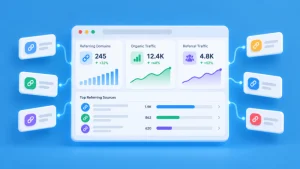
Link-building reporting should connect activity to outcomes.
| Benefit | Metric worth monitoring |
| Search visibility | Keyword positions and search impressions |
| Organic growth | Organic clicks and sessions |
| Authority development | Quality referring domains |
| Page strength | Links pointing to strategic URLs |
| Referral value | Referral sessions and conversions |
| Discovery | Crawling and indexing status |
| Link stability | New, lost and restored backlinks |
| Brand exposure | Mentions and referral sources |
| Commercial impact | Leads, enquiries or revenue influenced by referral/organic traffic |
This also protects you from one of the biggest link-building mistakes: celebrating a growing backlink count while organic performance remains unchanged.
Backlink acquisition should ultimately support business or search objectives—not just create a larger number inside Ahrefs, Semrush or another SEO platform.
What Backlink Metrics Should You Actually Trust?
SEO tools provide useful proprietary metrics such as Domain Rating, Domain Authority, Authority Score and similar measurements.
They are useful for comparison.
They are not Google ranking scores.
That distinction matters.
I would never approve a backlink simply because a website has “DR 70”.
I would investigate the actual website.
Does it rank?
Does it publish useful content?
Is the niche relevant?
Does it appear to have a real audience?
Where will the link appear?
Is the article indexed?
Does the website appear to exist primarily for selling links?
Is the surrounding content relevant to the destination?
Metrics should help you investigate a domain, not replace the investigation.
What Is the Best Way to Get Backlinks That Deliver Real Benefits?
The strongest links normally have a legitimate reason to exist.
That may come from original research, useful statistics, expert commentary, digital PR, unique tools, industry resources, partnerships, relevant directories, broken-link replacement, guest contributions or genuinely useful content that publishers want to reference.
ClickDo’s current resource on link-building techniques for quality backlinks covers the acquisition side in more depth.
Guest publishing can also work when the content genuinely serves the host publication’s audience and the backlink fits naturally within that content. Businesses considering this route can review how SEO-focused guest posting placements are structured around relevance and contextual placement.
The method matters less than one principle:
There should be a defensible editorial or user reason for the link to exist.
That single test eliminates a large amount of bad link building.
My 7-Point Backlink Quality Test
Before treating a potential link as valuable, I ask seven questions:
- Is the linking website genuinely relevant?
- Does the website appear to have real users and useful content?
- Is the source page crawlable and indexable?
- Will the link sit naturally inside relevant content?
- Would a human reader have a reason to click it?
- Is the destination page genuinely worth recommending?
- Would I still want the placement if SEO tools did not show DR or DA?
That final question is particularly useful.
If the only reason a backlink looks attractive is the number beside the domain in an SEO tool, I investigate it much more carefully.
Why the Importance of Backlinks in SEO Is Really About Quality?
The importance of backlinks in SEO has not disappeared.
What has changed is the standard required to make link building worthwhile.
Backlinks can support rankings, discovery, referral traffic, brand visibility and competitive authority. But those benefits are not automatically attached to every hyperlink pointing towards a website.
Relevant links from credible pages with a genuine editorial purpose are fundamentally different from mass-produced links placed solely to manipulate rankings.
That is the point I would want any business owner to understand before investing in link building.
Do not build backlinks simply because an SEO tool says your competitor has more.
Understand which links are helping competitors, which pages need additional authority, which publishers genuinely matter in your market and what business result each campaign is supposed to produce.
When those pieces line up, backlinks stop being vanity metrics.
They become part of a measurable SEO growth strategy.
Frequently Asked Questions
What are the main backlinks benefits?
The main backlinks benefits include stronger search visibility, additional crawling and discovery paths, referral traffic, brand exposure and external signals of relevance. Their value depends heavily on the quality and context of the linking source.
Why are backlinks important in SEO?
Backlinks are important in SEO because Google uses links for page discovery and as one signal for understanding relevance. Strong, relevant backlinks can also send traffic and strengthen a page’s competitive position.
Do backlinks automatically improve rankings?
No. A backlink does not guarantee a ranking increase. Search intent, content quality, technical SEO, competition, relevance and the quality of the linking source all influence the result.
Is backlink quality more important than quantity?
Quality should normally come first. A smaller number of relevant editorial backlinks from credible websites can be substantially more useful than large numbers of weak or unrelated links.
Are nofollow backlinks useful?
Yes. They may still generate referral traffic, brand exposure and discovery opportunities. A natural link profile can contain ordinary, nofollow, sponsored and UGC links depending on how those links were created.
How can I tell if backlinks are benefiting my website?
Monitor relevant referring domains alongside keyword visibility, organic traffic, referral traffic, indexed pages, conversions and the performance of URLs receiving backlinks. Do not judge success from backlink count alone.