

When to start building links is one of the most important decisions in a website’s SEO strategy.
Start too early without useful content, a functioning website or clear target pages, and your outreach may generate little return.
Wait too long, and competitors may strengthen their backlink profiles while your website struggles to gain authority and search visibility.
From our analysis of link-building strategies, competitor backlink profiles and published industry guidance, we have found that the right time to start building links depends more on website readiness than domain age.
For a new website, foundational link building can begin as soon as the site is live, technically accessible and provides useful information.
More substantial editorial outreach should begin when the target pages offer a genuine reason for other websites to reference them.
Our recommendation: Start internal linking immediately, develop credible brand mentions during the launch period, and introduce targeted backlink outreach once your important content is ready.
This may happen within the first few weeks rather than after an arbitrary three- or six-month waiting period.
However, an established website with strong content and a clean backlink profile may be ready to begin a more ambitious campaign immediately.
When Is the Best Time to Start Building Links for SEO?
The best time to start building backlinks is when your website has a clear purpose, valuable content, accessible pages and a strategy for acquiring relevant editorial references.
There is no official Google rule requiring a website to be 30, 60 or 90 days old before it can earn backlinks.
A new website can legitimately attract links during its first week. For example, a business might receive a backlink from an industry association, supplier, partner or publication covering its launch.
The important distinction is between earning legitimate references and aggressively creating links primarily to manipulate search rankings.
Our recommended starting periods are:
| Website stage | Recommended activity | Readiness |
| Before launch | Internal linking, content preparation and outreach research | Preparation |
| First 1–14 days | Relevant brand profiles, genuine business references and initial relationships | Foundational |
| Days 15–30 | Selective outreach to relevant publications and partners | Conditional |
| Days 30–60 | Editorial links, resource promotion and targeted digital PR | Expansion |
| Days 60–90 | Competitor gap campaigns and repeatable outreach | Optimisation |
| Established website | Start or expand when content and technical checks are satisfactory | Strategic |
These periods are planning recommendations, not guaranteed SEO milestones.
A website that launches with extensive original research, strong partnerships and technically sound pages might earn editorial backlinks almost immediately.
Another site might require several weeks of content development before meaningful outreach becomes worthwhile.
We evaluate the readiness of the website rather than relying entirely on its age.
Why Should You Build Quality Content Before Backlinks?
Content quality is one of the most important factors determining whether link building will produce lasting value.
When a publisher receives a backlink request, the primary question is usually whether the destination page adds value for its readers.
If a page provides incomplete information, makes unsupported claims or merely repeats competing content, the publisher has little incentive to reference it.
As I have previously explained on my website:
“Trying more shortcuts and irrelevant bunch of backlinks will harm your SEO.”
— Dinesh Kumar VM, Senior SEO Consultant
This reflects a principle that should guide the beginning of every campaign: establish the website’s quality before attempting to increase its authority.
Before actively approaching publishers, we recommend creating a suitable foundation comprising an informative homepage, clear service or product pages, trustworthy business information and useful supporting content.
For example, a SaaS company might create an original integration comparison, an interactive calculator or a technical implementation guide.
A financial services website might publish clearly sourced research or an educational resource reviewed by a suitably qualified professional.
These assets provide something worth referencing.
The same principle applies to publishers themselves.
Fernando Raymond, SEO Expert, has explained in his published article about building niche blogs:
“build the blog so well that you have nothing to hide.”
— Fernando Raymond, SEO Expert
His advice highlights the importance of building a credible, useful website before expecting commercial or editorial relationships to develop.
We apply that thinking to both sides of link acquisition: the website earning the backlink and the publisher considering whether to provide one.
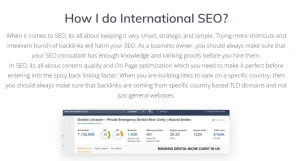
My published explanation of why content quality and on-page SEO should be prioritised before aggressive backlink building.
How Do You Know Whether Your Website Is Ready for Link Building?
Rather than using domain age as the primary indicator, we recommend evaluating six readiness factors.
These can be combined into a percentage-based assessment that helps businesses decide when to begin outreach.
Our Link-Building Readiness Assessment
| Readiness factor | Weight |
| Technical accessibility and indexability | 20% |
| Content quality and usefulness | 25% |
| Clear search intent and target pages | 15% |
| Internal linking and website structure | 15% |
| Editorial value and linkworthiness | 15% |
| Conversion readiness and tracking | 10% |
| Total | 100% |
These percentages represent our editorial assessment weights, not Google’s ranking algorithm or published conversion statistics.
A technical problem that prevents the target page from being accessed or indexed should be treated as a critical blocker regardless of its total score.
How to Interpret the Readiness Score?
| Score | Our assessment | Recommended action |
| 85–100% | Excellent readiness | Begin focused editorial outreach |
| 70–84% | Good readiness | Start selectively and improve weaker areas |
| 50–69% | Limited readiness | Prioritise content and technical improvements |
| Below 50% | Poor readiness | Delay substantial acquisition campaigns |
Consider two hypothetical business websites.
Website A has useful service pages, a well-researched resource, clear navigation, Search Console tracking and a functioning enquiry process. It achieves an illustrative readiness score of 88%.
Website B has thin content, poorly connected pages and unresolved technical problems. It scores 49%.
Our recommendation would be to begin targeted outreach for Website A while improving Website B before committing a significant budget.
These scores indicate preparation, not the percentage probability of ranking success.
What Should You Do During the First 90 Days of Link Building?
A well-managed link-building campaign should develop progressively through website preparation, relationship building, editorial promotion and performance monitoring.
For a new business website, we recommend the following roadmap.
Days 1–14: Establish the SEO Foundation
During the initial two weeks, concentrate on ensuring the website is functioning correctly and contains information that publishers and customers can trust.
The essential tasks are:
- Verify the domain in Google Search Console.
- Submit an XML sitemap.
- Confirm important pages are accessible and indexable.
- Review page titles, canonical tags and mobile usability.
- Publish core commercial pages and supporting content.
- Create natural internal links between relevant pages.
- Identify the first potential editorial partners.
We also recommend checking whether Google has discovered and indexed important URLs.
However, full indexation is not a mandatory waiting condition for every legitimate backlink. A useful, crawlable page can earn references before its indexing status has been confirmed.
For technically sound websites, early partnerships and brand references can be developed while indexing is progressing.
The objective is to avoid investing heavily in promotion when visitors would arrive at an incomplete or unsuitable destination.
Days 15–30: Build Your First Relevant Backlinks
During this stage, identify opportunities connected to your industry, audience and business relationships.
Potential sources include trade associations, legitimate local directories, business partners, professional organisations and specialist publications.
We recommend evaluating each opportunity according to topical relevance and audience usefulness rather than relying only on third-party domain metrics.
Our detailed assessment of relevant backlinks explains how page relevance, industry alignment and editorial context affect prospect selection.
For a local accounting firm, a useful association listing or regional business publication may be more appropriate than a general website offering backlinks across unrelated topics.
For an international technology company, specialised SaaS publications and industry resources may present stronger opportunities.
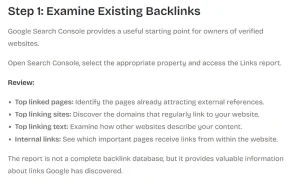
Reviewing backlink information in Google Search Console before planning the first editorial outreach campaign.
Days 31–60: Develop Editorial Authority
Once useful pages are published and the website’s foundation is established, expand into editorial link acquisition.
At this stage, we recommend prioritising:
- Genuine editorial contributions to relevant publications.
- Digital PR based on real business developments or original research.
- Resource-page outreach where your content adds value.
- Reclaiming legitimate unlinked brand mentions.
- Replacing broken references with genuinely suitable resources.
One approach is broken link building, where a publisher is alerted to an outdated or broken reference and offered a relevant working replacement.
This tactic is most appropriate when your resource meets the original reader’s need.
For example, if a technology publication links to an obsolete software comparison, a current, independently useful comparison may provide a reason for the editor to update that reference.
The aim should be to improve the publication’s content, not simply persuade it to insert a backlink.
Days 61–90: Expand and Measure Your Results
By this stage, the campaign should have enough operational information to identify which approaches deserve additional effort.
We recommend reviewing acquired referring domains, the quality and relevance of placements, outreach responses, referral traffic and changes in search visibility.
Compare current performance with the baseline established at launch.
If relevant publications regularly reference an informational resource but your service pages remain underexposed, consider improving internal linking between those assets.
If outreach responses are poor, examine whether your content offers anything genuinely new before increasing the number of emails sent.
Our assessment of the benefits of backlinks provides additional context for measuring brand exposure, referral traffic and search performance.
A sustainable campaign should evolve from the evidence collected rather than continue repeating ineffective outreach activities.
Should You Build Backlinks Before Your Website Starts Ranking?
Yes. A website does not need to rank on Google’s first page before it can begin earning backlinks.
In fact, relevant backlinks may support discovery, referral traffic and the development of search visibility.
However, it is important to distinguish between a website that has not gained rankings because it is new and one that cannot rank because of technical or content problems.
If the site is new, useful and technically accessible, relevant outreach can begin.
If important pages are excluded from indexing, have incorrect canonical tags or fail to meet search intent, those issues should be investigated first.
We recommend checking Google Search Console for indexing information and baseline impressions before committing significant resources.
Starting early does not mean creating hundreds of backlinks in a short period.
It means making the website visible to relevant people and organisations as soon as it offers something worth discovering.
How Can Competitor Backlink Analysis Help You Decide When to Start?
Competitor backlink analysis can provide a clearer view of the authority and editorial relationships needed to compete in a particular market.
We recommend reviewing three to five relevant organic-search competitors before building a large outreach list.
A practical backlink gap analysis identifies websites that link to competitors but do not currently link to your domain.
However, not every missing backlink represents a useful opportunity.
The most valuable questions are:
- Why did the publisher link to the competitor?
- What information or resource was being referenced?
- Does our website offer something comparable or better?
- Is the publication relevant to our audience?
- Can we establish a legitimate editorial relationship?
Suppose three competing project-management platforms receive backlinks from specialist productivity blogs.
A deeper review might reveal that the links point to free templates, original surveys or software integration tutorials.
That finding suggests that producing a genuinely useful resource may be the correct first step before outreach.
Our competitor backlink analysis process explains how to evaluate referring domains, editorial context and acquisition patterns.
In competitive markets, we also analyse which individual pages attract references rather than comparing total domain backlinks alone.
This helps businesses avoid investing in placements that do not support their actual SEO and commercial objectives.
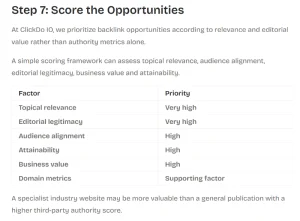
Evaluating competitor backlink opportunities before committing resources to an outreach campaign.
Which Link-Building Strategies Should You Prioritise First?
Not all backlink acquisition methods are equally suitable for a website in its early stages.
We recommend selecting techniques according to content readiness, business relevance, potential referral value and editorial legitimacy.
Our Editorial Ratings for Link-Building Strategies
| Strategy | Suitability rating | Recommended starting point |
| Genuine business associations and partner references | 90% | At or shortly after launch |
| Useful resource-page outreach | 90% | When the resource is ready |
| Original research and digital PR | 92% | When there is a newsworthy asset |
| Broken link building | 85% | When a suitable replacement exists |
| Reclaiming unlinked brand mentions | 88% | Whenever genuine mentions are found |
| Relevant independent editorial contributions | 84% | After establishing expertise |
| Generic low-quality directory submissions | 20% | Generally avoid |
| Automated links created to manipulate rankings | 0% | Not recommended |
Ratings are our qualitative assessments of suitability for a prepared business website, not measured success rates or Google ranking-factor percentages.
The strategy with the highest rating is not necessarily the best choice for every company.
For example, an established publisher with original data may be well positioned for digital PR. A new local business may gain more immediate exposure through legitimate industry memberships and existing supplier relationships.
Our recommendation is to select the method that offers a credible reason for another website to reference the business.
Which Pages Should Receive Backlinks First?
One of the most common link-building mistakes is directing every acquired backlink to the homepage.
Although homepage references are natural and valuable, they should not be the only objective.
We recommend distinguishing between linkable assets and commercial target pages.
A linkable asset might be an original research report, an educational article, a calculator or an industry resource.
A commercial page might describe a service, product category or solution that generates enquiries or sales.
The connection between these page types is important.
For example, a payroll software company might publish an independently useful guide to calculating payroll costs. Industry publications may find that guide relevant enough to reference.
The guide can then connect readers naturally to the company’s related payroll services and products through internal links.
This creates a practical relationship between editorial visibility and commercial opportunity.
Before selecting a destination URL, consider:
- Does the page directly answer the linking publication’s reader need?
- Does it provide unique or particularly useful information?
- Is the content accurate and current?
- Can readers easily navigate to related resources?
- Does the destination remain relevant if its commercial offering changes?
The strongest target pages tend to satisfy several of these conditions.
For further planning, our process for finding backlinks to a website can help identify which existing pages are already attracting external references.
Should New Websites and Established Websites Follow the Same Strategy?
New and established websites can use similar acquisition methods, but their priorities are different.
New Websites
New domains usually need to establish their identity, publish useful information and develop their first legitimate industry relationships.
We recommend beginning with relevant business references, foundational content promotion and selective outreach.
The aim is not to achieve an arbitrary backlink count. It is to build a credible base of references that introduces the website to the appropriate audience.
Established Websites
Established domains may already have linkable content, brand recognition and an existing backlink profile.
Their priorities may include identifying unlinked brand mentions, promoting underlinked pages, conducting competitor gap analysis and developing new editorial assets.
There is usually no reason to impose a waiting period on an established website whose content and technical health are satisfactory.
Websites Recovering From SEO Problems
A website experiencing a visibility decline needs diagnosis before additional backlink acquisition.
Ranking losses can result from many causes, including content changes, technical issues, market competition, search demand and spam-related problems.
A third-party tool’s toxic-link label does not automatically establish that Google has penalised a website.
Our analysis of how to find toxic backlinks explains why backlink problems require careful investigation rather than indiscriminate removal or disavowal.
How Long Does Link Building Take to Produce SEO Results?
Businesses should separate the time required to acquire a backlink from the time needed to observe any possible search-performance impact.
These are different processes.
An outreach campaign may secure an editorial placement within days or require several months of relationship development.
After publication, Google must discover and process the linking page. Any subsequent ranking change depends on additional factors, including website quality, search intent, competition and other ranking signals.
We recommend using three reporting stages:
| Measurement stage | What to track | Main objective |
| First 30 days | Outreach activity, placements and technical status | Establish execution |
| Days 30–90 | Relevant referring domains, referral traffic and impressions | Identify early signals |
| Months 3–6 and beyond | Search visibility, qualified traffic, leads and revenue | Evaluate business impact |
These are recommended review periods, not guaranteed result windows.
We advise against promising that a particular number of backlinks will produce a specific ranking within a fixed period.
It is also misleading to claim that each link passes an identical amount of ranking value.
A single relevant editorial reference can be strategically useful, while a large volume of low-quality links may provide little benefit.
The most reliable assessment considers the complete website and campaign.
How Much Should You Invest in Link Building?
Link building should be treated as a business investment rather than simply a monthly backlink-purchasing exercise.
The total investment may include research, content production, outreach, publisher communication, technical optimisation and reporting.
We recommend establishing a clear business objective before assigning a budget.
For a lead-generation company, that objective might be increasing qualified enquiries. For an eCommerce business, it might be growing profitable organic sales. For a publisher, it may be increasing relevant audience reach.
A basic return-on-investment calculation is:
ROI (%) = [(Incremental gross profit attributable to the campaign − Campaign cost) ÷ Campaign cost] × 100
Consider a hypothetical business spending £1,000 on an SEO campaign during a measurement period.
If the campaign generates £1,500 in attributable incremental gross profit, its calculated ROI would be:
ROI = (£1,500 − £1,000) ÷ £1,000 × 100 = 50%
However, attributing that improvement exclusively to backlinks may not be possible.
Content changes, technical improvements, advertising, seasonality and brand demand can also influence business results.
We recommend measuring link-building performance within the wider SEO programme and documenting attribution assumptions.
This is particularly important for businesses deciding whether to increase their monthly investment.
What Mistakes Should You Avoid When Starting Link Building?
The following mistakes can reduce effectiveness or introduce unnecessary risks.
Building links to weak pages. Publishers are less likely to reference a resource that adds little value. Improve the destination before increasing outreach.
Prioritising backlink quantity over quality. A large number of links is not proof of authority or commercial relevance. Examine the actual linking pages.
Relying exclusively on Domain Rating. DR and DA are third-party metrics, not official Google ranking scores.
Repeating exact-match commercial anchor text. Attempting to control anchors unnaturally can create manipulative patterns. Editorially chosen anchors should accurately describe the linked resource.
Buying links intended to manipulate rankings. Google’s spam policies prohibit schemes designed to pass ranking credit through paid placements. Advertising and sponsored links should be appropriately qualified using rel=”sponsored” or rel=”nofollow”.
Ignoring internal linking. External references are only one part of SEO. Readers and search engines should be able to navigate from useful resources to related pages.
Assuming every traffic decline is a backlink penalty. Investigate the complete SEO environment before taking corrective action.
Stopping after the first placements. Link building is most effective as a sustained process of publishing useful resources and developing legitimate editorial relationships.
Fernando Raymond’s published observations about high-quality niche publishing are relevant here. Editorial credibility, real audiences and consistent content standards are more valuable foundations than a website created primarily to accommodate links.
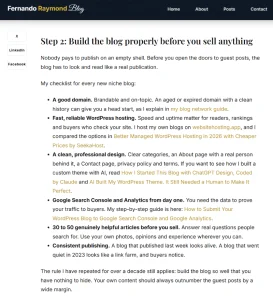
Fernando Raymond’s published advice on building a credible niche website with strong content standards before monetising editorial opportunities.
How Should You Monitor Backlinks After Starting?
Monitoring should begin with the first acquisition activity rather than several months later.
We recommend establishing a baseline before outreach and maintaining a consistent campaign record.
Track the linking URL, referring domain, destination page, link attribute, publication date, editorial relevance and any known relationship to the publisher.
Then review the following measures:
| Metric | Why it matters |
| New relevant referring domains | Shows growth in distinct external references |
| Lost or changed backlinks | Identifies references requiring review |
| Referral traffic | Measures direct visits from linking pages |
| Organic impressions | Indicates changes in search visibility |
| Target keyword performance | Helps assess progress on strategic queries |
| Organic conversions | Connects SEO activity to commercial outcomes |
| Outreach response rate | Helps evaluate prospecting and content appeal |
Our comparison of backlink monitoring tools covers platforms that can assist with tracking acquired and lost backlinks.
For businesses without a large software budget, Google Search Console remains a useful starting point for reviewing known external links and organic search performance.
However, backlink reports are not always complete, and different SEO platforms may report different totals because they maintain separate crawling databases.
We recommend monitoring trends consistently rather than treating any single platform’s backlink count as an exact measure of all links on the web.
Does Link Building Still Matter for AI Search Visibility?
Link building remains relevant to digital discovery, but businesses should be careful about overstating its direct influence on AI-generated search responses.
Credible publishers may introduce a brand to readers who subsequently search for it, reference it or discuss it elsewhere.
Original research, expert commentary and useful resources may also become candidates for citation by search tools that retrieve external information.
However, there is no reliable universal formula linking a particular number of backlinks to AI Overview appearances or chatbot mentions.
Our recommendation is to develop resources that deserve references regardless of the discovery platform.
An original report, clearly attributed expert explanation or well-maintained research resource can serve conventional search, referral audiences and AI-assisted discovery.
The same strategic principle applies: publish something valuable before asking the market to promote it.
Final Thoughts
The right time to start building links is when your website is capable of delivering value to the people who discover it.
For a new website, that may mean beginning with genuine brand references during the first few days and gradually expanding into editorial outreach as useful content becomes available.
For an established website, the right time may be immediately after confirming the campaign’s objectives and identifying worthwhile opportunities.
Our assessment is that website readiness, editorial relevance and measurable business value matter more than domain age or backlink volume.
Build the foundation first, choose relevant publishers, promote genuinely useful resources and monitor the commercial impact of the campaign.
That approach provides a stronger basis for sustainable search visibility than following an arbitrary backlink-building calendar.
Frequently Asked Questions About When to Start Building Links
Can I Start Building Backlinks on a New Website Immediately?
Yes. A new website can legitimately earn backlinks from launch, provided its pages are accessible and useful. Start with appropriate brand mentions and genuine relationships. Scale editorial outreach when there is a suitable page to promote.
Should I Wait 30 Days Before Building Backlinks?
No fixed 30-day waiting period is required by Google. The first month is a useful planning period for establishing content, indexing checks and relationships, but a well-prepared website may begin sooner.
How Many Backlinks Should I Build in the First Month?
There is no universal safe or effective number. A target should reflect the website’s industry, available editorial opportunities and campaign resources. Prioritise relevance and legitimacy rather than trying to meet a fixed link quota.
Can I Build Backlinks Before Google Indexes My Website?
Yes, legitimate external websites can link to a page before Google indexes it. However, the destination should be accessible and eligible for indexing, and any indexation problems should be investigated.
A backlink does not guarantee that Google will index the page.
Is It Better to Build Backlinks or Publish More Content First?
If the website lacks useful resources, content improvement should take priority. If important pages are already strong, content promotion and backlink outreach can run alongside ongoing publishing.
Is Link Building Necessary for Low-Competition Keywords?
Not always. Some low-competition queries can attract organic traffic with strong, relevant content and sound technical SEO. Backlinks can be useful, but they should not automatically be treated as a prerequisite for every ranking opportunity.
Should I Build Backlinks Every Month?
A consistent approach can help maintain publisher relationships and develop long-term visibility. However, the campaign should respond to genuine opportunities and business needs rather than acquire links solely to satisfy a monthly quota.